Affichage des articles dont le libellé est Egypte. Afficher tous les articles

samedi 28 septembre 2013

Egypte: Première tablette numérique égyptienne prochainement sur les marchés local et arabes

L'Egypte sort sa toute première tablette numérique qui sera distribuée fin de cette année à destination des élèves et des étudiants de tout le pays, ainsi que sur les marchés arabes, à un prix modique de 1777 L.E.

Ce plan national a été initié par les ministères de la production militaire et de la communication.

Objectif : remplacer les livres et les ordinateurs portables dans les établissements scolaires afin de moderniser le système éducatif.

dimanche 8 septembre 2013

Egypt Plans to Set Up National Agency for Space

Egypt is planning to set up a national agency for space, said Head of the National Agency for Remote Sensing Medhat Mokhtar on Thursday 05/09/2013.

In statements to MENA, Mokhtar noted that the proposed agency will be an independent entity from the remote sensing authority.

The new agency will directly answer to the presidency of the republic, Mokhtar said, adding that such a status will allow it to carry out vital and strategic activities that are important to the State.

A draft law on this score will be referred later today to the scientific adviser to the president to proceed later to the president, he pointed out, adding that the new project gives room to cooperation with different world countries.

6 SEPTEMBER 2013

mardi 9 juillet 2013

The Muslim Brotherhood’s Legacy: Controls, Shortages and Inflation

The Muslim Brotherhood and President Morsi never had a credible plan for the Egyptian economy. Indeed, I doubt that the Brotherhood’s leaders know the meaning of the word “plan”. Over the past year, economic conditions in Egypt have gone from bad to worse. And, it seems Morsi’s brief tenure as president will likely be remembered largely for its shameful economic record – one marred by a decline in GDP growth, a reduction in foreign reserves, and a sharp increase in unemployment.

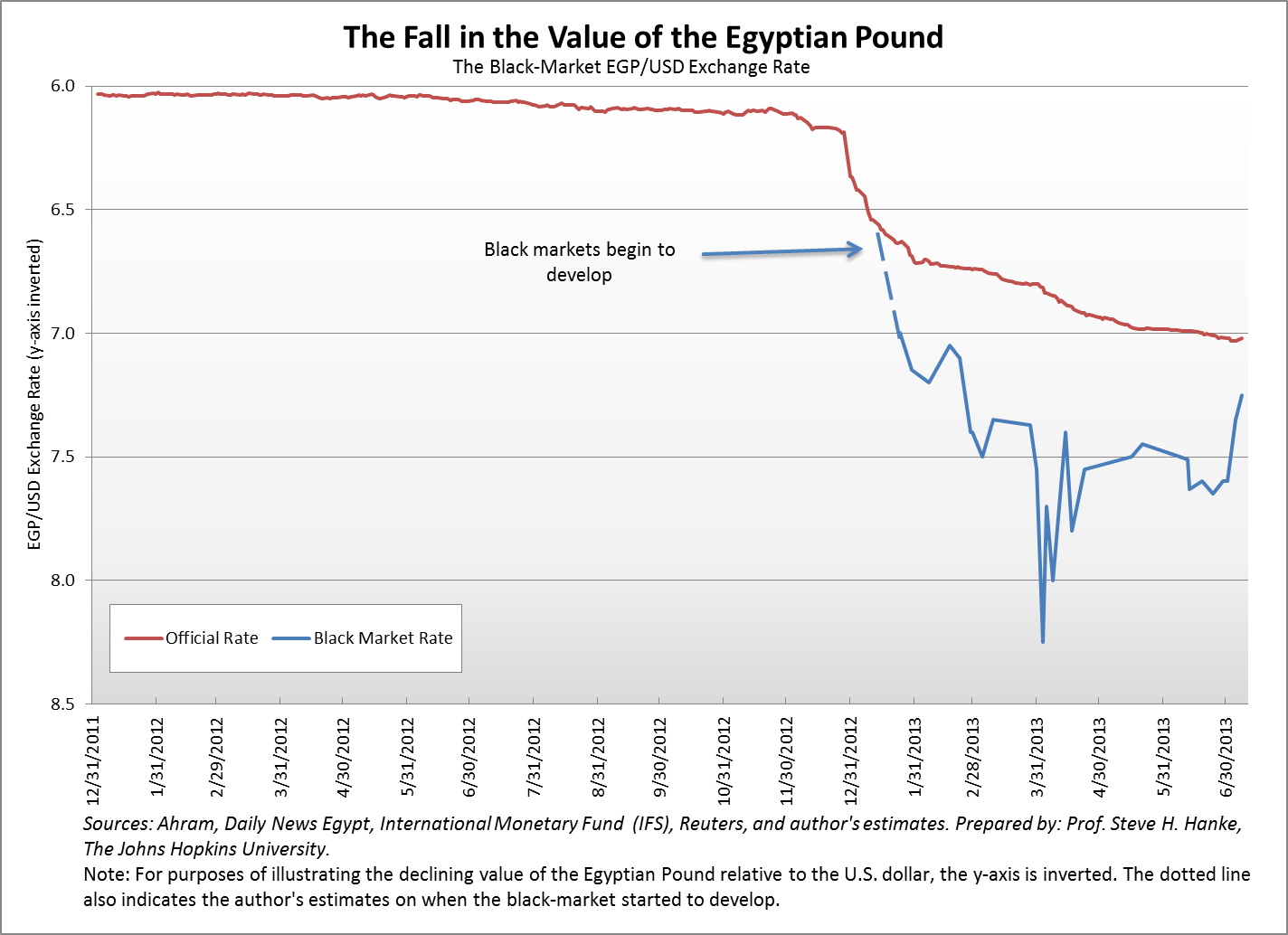
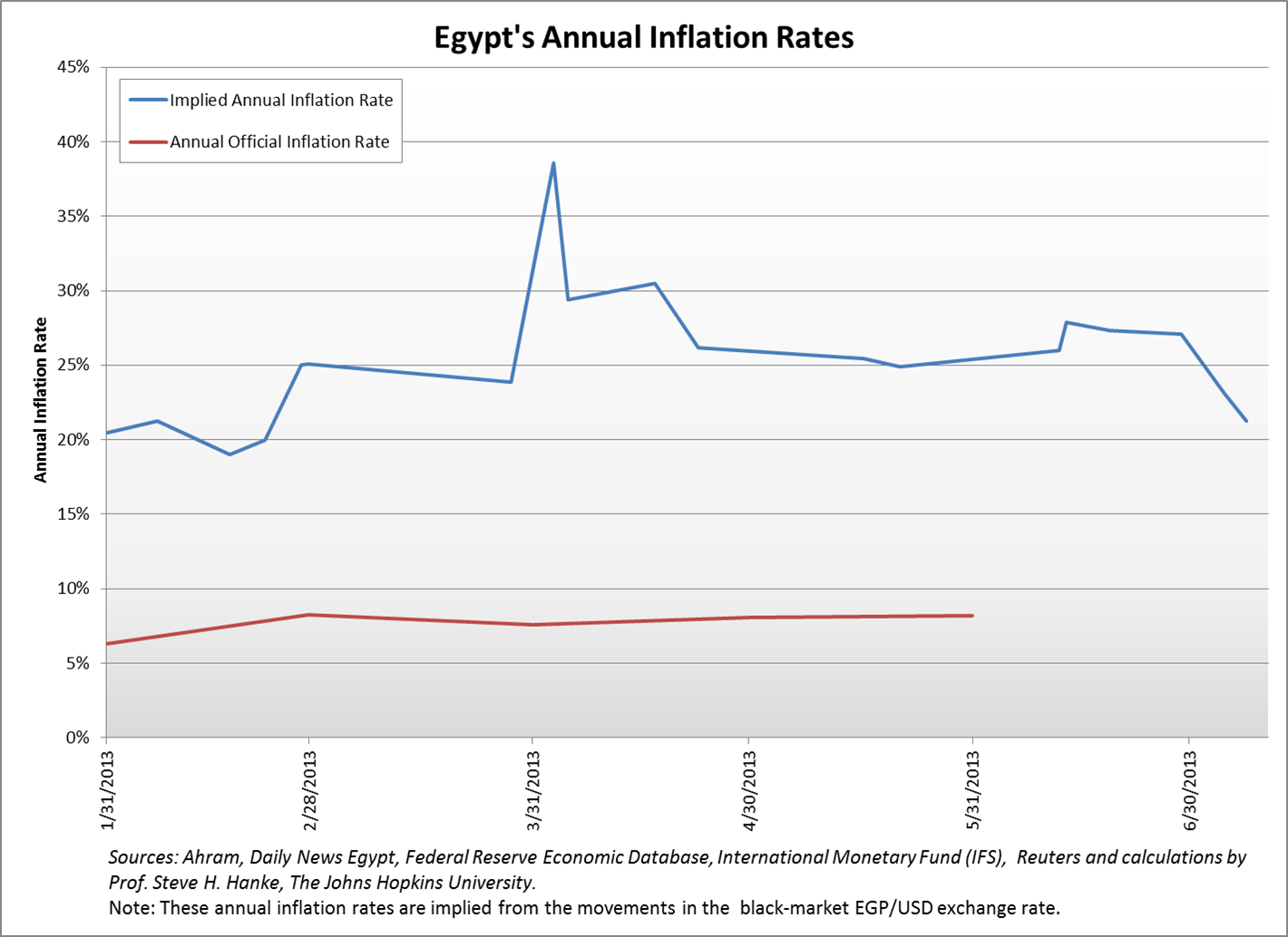
Black markets have also been a hallmark of the Muslim Brotherhood’s economic legacy. Price and capital controls have caused shortages and a substantial slide in the value of the Egyptian pound. In consequence, Egyptians have watched inflation destroy their standard of living. Additionally, controls have delivered shortages of foreign exchange and many goods, likegasoline. In the face of the Brotherhood’s wrongheaded economic policies, official inflation and price statistics took leave of reality, and the black market quickly became a source of material support that the Muslim Brotherhood’s government could not provide.

Yes, as the accompanying charts illustrate, the story of a failing Egyptian economy is the story of a troubled Egyptian pound – and of the inflation troubles (21.2% annually) that accompanied it.


These trends have proven fatal for Morsi and the Brotherhood. While Morsi’s final hours were filled by lectures on “constitutional legitimacy”, Egyptians weren’t listening – they were preoccupied with a plunging pound and an inflation rate that is roughly two and a half times higher than the official rate. Morsi and the Muslim Brotherhood’s policies, of course, contributed mightily to the implosion of the Egyptian economy. In the final analysis, the Egyptian people have taught Morsi and the Muslim Brotherhood a harsh lesson: bread is more important than ideas.

jeudi 4 juillet 2013

Egypt 2.0

For the second time in little more than two years the Egyptian military has overthrown its county's leader in response to massive nationwide protests. Only this time they deposed a democratically elected president, Mohammad Morsi, who had failed to live up to his promises and who had installed an authoritarian government.

Egyptian General Abdul-Fattah el-Sisi announced Wednesday evening that the Morsi government was dissolved, the constitution was suspended, and that an interim government would be installed headed by a senior jurist. Military officers and a group of political and religious leaders joined el-Sisi at his announcement. The announcement set off a jubilant celebration in Cairo's Tahrir Square, where tens of thousands of anti Morsi demonstrators had gathered. Meanwhile, a few blocks away, a large gathering of pro Morsi supporters protested the coup. The Egyptian army had been deployed to maintain peace, but violence may not be avoided.

Former President Mohammad Morsi is a member of the Muslim Brotherhood, a decades old Islamic and political group founded on the belief that Islam is not just a religion, but a way of life. Last November, Morsi granted himself unlimited powers, including the ability to legislate without judicial oversight. His moves toward an Islamic state were unpopular with many Egyptians who took to the streets to express their unhappiness.

During Morsi's presidency unemployment skyrocketed, crime increased, the economy declined, and the country experienced shortages of gasoline, electricity and water. Morsi proved to be a poor manager and an unpopular president.

Nonetheless, the country is deeply divided between those wanting a sectarian government and those wanting an Islamic state. But, following the tyrannical rule of former Egyptian strongman Hosni Mubarak, the only political party of any consequence was the Muslim Brotherhood. And its party members were more easily mobilized when Egypt held its democratic election one year ago. The opposition was divided and had no strong leadership. Morsi won 51.7% of the vote, thus eking out a victory.

The sacking of Morsi puts President Barack Obama and the American government in a difficult spot. The White House released a statement from the president Wednesday night, in response to Morsi's toppling, which reflected America's dilemma. "We are deeply concerned by the decision of the Egyptian Armed Forces to remove President Morsi and suspend the Egyptian constitution," Obama said. "I now call on the Egyptian military to move quickly and responsibly to return full authority back to a democratically elected civilian government as soon as possible through an inclusive and transparent process, and to avoid any arbitrary arrests of President Morsi and his supporters," he continued.

Egypt, the most populous Arab country, is a critical American ally. Egypt has continued to live by its vital peace agreement with neighboring Israel. Each year America provides the country about $1.5 billion in military and other aid. But that aid can be cut off in the event of a military coup. In his statement, the president said, "I have also directed the relevant departments and agencies to review the implications under U.S. law for our assistance to the Government of Egypt."

Further complicating the situation is the fact that the Egyptian military is holding Morsi and has rounded up as many as 300 leading members of the Muslim Brotherhood. These actions have cast a cloud of uncertainty over an already confusing situation.

While the U.S. can try to exert pressure for a quick return to a democratic state, ultimately it will be up to the Egyptian military to move the country forward. But its promise of a roadmap for reconciliation will face great challenges because the country so deeply divided, and the Muslim Brotherhood will be more energized than ever.

The whole world will be watching, especially Turkey, Syria, Iran and Israel.

Joe Peyronnin
Hofstra Journalism Professor

Posted: 07/03/2013 11:39 pm

http://www.huffingtonpost.com/joe-peyronnin/egypt-20_b_3544295.html

dimanche 20 mai 2012

Will economy trump Islam in Egypt?

Article by: JEFFREY FLEISHMAN , Los Angeles Times
Updated: May 19, 2012 - 7:09 PM

For many voters, Egypt's landmark presidential election should focus on restoring nation's prosperity, not religion.

An Egyptian woman stands in front of a mural depicting military ruler Field Marshal Hussein Tantawi, on the left side of the face and ousted president Hosni Mubarak, right side, in Cairo, Egypt, Saturday, May 19, 2012. Egyptians are for the first time freely electing their president starting May 23-24.
Photo: Manu Brabo, Associated Press

CAIRO - Adham Bishr said Egypt's next president should give him a job, not tell him how to worship God.

Men gathered around Bishr in a scrap of shade by the Nile, arguing over inflation and politics before disappearing into the grit and anger of a neighborhood at Cairo's edge. The men, mostly unemployed drivers, mill hands and laborers, want work; their sons, college students with dim prospects, wonder whether the future will bring enough money to take a wife.

"I don't care about how much Islam is in the government," said Bishr, laid off years ago from a sugar factory. Before that, during decades when Egypt paid unlivable wages, he built roads in Iraq and welded metal in Saudi Arabia. "I want a president who will rebuild our country. We need to rise again to greatness."

Egypt is hobbled by economic turmoil, poor health care, failing social programs and lack of security. The top candidates in the presidential election that begins Wednesday have addressed these concerns, but the issues have often been eclipsed by passion over how deeply Islam should permeate a new constitution and government.

Start of a new era

The election will set the trajectory and tenor of an untested political Islam emerging from more than a year of Arab uprisings. It's a struggle between ultraconservatives and liberals over whether Egypt should lean toward the fundamentalism of Saudi Arabia or the moderate inclinations of Turkey. The discourse is driven by influential scholars and clerics who invoke piety as a political barometer.

Most Egyptians agree that Islam should guide national policy. But men like Bishr -- more than 40 percent of Egyptians live on less than $2 a day -- fear that the elite's preoccupation with religion and talk of reviving centuries-old caliphates are diversions from the country's entrenched problems. Such sentiment is shared miles away in cafes frequented by the young professionals.

"We need to get the economy on its feet," said Shady Ghoneim, an electronics importer who supports leading secular candidate Amr Moussa. "Foreign investors won't come back unless they can trust a moderate president."

The landmark vote promises to end an era of autocratic rule that began in 1952, when Gamal Abdel Nasser led a military coup that freed Egypt from colonial rule. Since then, the nation has known only military men as its presidents. The question is whether the Arab world's most populous state is prepared to deliver an Islamist to the palace.

The choices Egyptians face among the top candidates are clear and symbolize the contentiousness over how to move beyond the legacy of Hosni Mubarak, who was ousted last year. Moussa, a former foreign minister, promises to offer a secular balance against a parliament controlled by Islamists. He is challenged by Abdel Moneim Aboul Fotouh, a liberal Islamist straining to appease moderate and ultraconservative sensibilities, and Muslim Brotherhood hopeful Mohamed Morsi, who has veered toward hard-line clerics.

Prosperity denied

Morsi's place of third or fourth in the polls indicates that respondents, about 40 percent of whom say they are undecided, are suspicious of the Brotherhood and seek a candidate less driven by religious dogma than enshrining a civil state. That's true for Bishr and the men of the Tora neighborhood, which echoes with tales of prosperity denied.

Bishr took part in last year's uprising in Tahrir Square. Most of his friends did not, and Tora, like many working-class and poor neighborhoods, watched from the outskirts as history unfolded. Parents here hustle for handyman jobs and subsidized bread; they want Egypt kept out of wars and enough household money to fix broken shutters and sagging walls.

"The poor should be the first priority," said one man. "Egyptians are merciful," said another. "We already have Islam in our hearts."

http://www.startribune.com/nation/152161475.html