Affichage des articles dont le libellé est astronomie. Afficher tous les articles

lundi 7 octobre 2013

How Do Astronomers Measure Distance?


howstuffworks:

Since astronomers can’t actually travel to a star, they rely on two ingenious methods to measure a star’s distance from earth. Watch BrainStuff break down the science of space measurement in this episode.

(via osastar)

Oct 7, 2013 1:36 am by: kenobi-wan-obi

http://scinerds.tumblr.com/post/63352810750/howstuffworks-how-do-astronomers-measure

dimanche 29 septembre 2013

Aussi brillant qu’un million de soleils : le trou noir au cœur de la Voie Lactée serait sur le point d'exploser

Le trou noir supermassif au centre de notre galaxie, la Voie Lactée, consommera bientôt une goutte de gaz qui le fera rayonner d'énergie à un rythme effréné.


L'anéantissement de ce nuage de gaz pourrait durer plus d'un an

Rien n'est plus tranquille que l'étendue de la Voie Lactée flottant dans le ciel d'une nuit d'été. Enfin, c'est ce que vous pensez ! En réalité, le centre de notre galaxie est un chaos d'étoiles et de débris qui tournent autour d'un immense trou noir qui fait 4 millions de fois la masse du soleil. Et les choses ne sont pas prêtes de se calmer. Des astronomes ont découvert qu'une boule de gaz, appelée G2, s'est égarée et se dirige actuellement vers le trou noir.

Ce gaz avance très vite. A tel point qu'il entre en collision avec d'autres matières, se réchauffe et émet une grande quantité d'énergie. Le trou noir va bientôt consommer cette boule de gaz. Un événement similaire s'est produit il y a une centaine d'années, créant un éclat de lumière aussi brillant qu'un million de soleils. Une donnée parvenue à notre connaissance grâce aux échos de lumière qui rebondissent autour du centre de la galaxie. Selon le astronome du MIT Sheperd Doeleman, l'anéantissement de ce nuage de gaz pourrait durer plus d'un an. Elle considère d'ailleurs ce moment comme "un événement unique dans une vie".


Le trou noir central a beau être immense, il reste mille fois trop petit pour être observé avec le télescope spatial Hubble. Il est également obscurci par la poussière interstellaire qui bloque toute la lumière visible, bien que certaines ondes radio peuvent passer à travers. C'est pour cela que Sheperd Doeleman organise l'Event Horizon Telescope, un projet qui vise à créer un réseau international d'antennes paraboliques qui, ensemble, représentent un système dont le diamètre effectif est aussi important que celui de la Terre.

D'ici deux ans, le réseau de l'Event Horizon Telescope augmentera donc considérablement ses capacités d'observation. Une trentaine de radiotélescopes devraient rejoindre d'ici 2015 les quatre appareils qui en font déjà partie. Selon Sheperd Doeleman, le radiotélescope ainsi créé permettra également de réaliser des observations inédites de Sagittarius-A et de son disque d'accrétion. L'Event Horizon Telescope a déjà permis de relever de nouvelles données concernant la galaxie M87.

Publié le 28 septembre 2013

samedi 28 septembre 2013

How Do Black Holes Form?


Black holes are the most exotic and awe inspiring objects in the Universe.

Take the mass of an entire star. Compress it down into an object so compact that the force of gravity defies comprehension.

Nothing, not even light, can escape the pull of gravity from a black hole.

The idea was first conceived in the 18th century by the geologist John Mitchell. He realized that if you could compress the Sun down by several orders of magnitude, it would have gravity so strong that you’d need to be going faster than the speed of light to escape it.

Artist’s conception of the event horizon
of a black hole. Credit: Victor de
Schwanberg/Science Photo Library
Initially, black holes were considered nothing more than abstract mathematical concepts; even Einsten assumed they didn’t actually exist. But in 1931, the astronomer Chandrasekhar calculated that certain high mass stars might be able to collapse into black holes after all.

They turned out to be real, and over the next few decades, astronomers found many examples out in the Universe.

Stars are held in perfect balance by two opposing forces. There’s the inward pressure of gravity, attempting to collapse the star, counteracted by the outward pressure of the emitted radiation.

This artist’s concept illustrates a
supermassive black hole with millions to
billions times the mass of our sun.
Supermassive black holes are
enormously dense objects buried
at the hearts of galaxies. Image
credit: NASA/JPL-Caltech

At the core, millions of tonnes of hydrogen are being converted into helium every second, releasing gamma radiation. This fusion process is an exothermic reaction, meaning it releases more energy than it requires.

As the star consumes the last of its hydrogen, it switches to the stockpiles of helium that it has built up. After it runs out of helium, it switches to carbon, and then oxygen.

Since the star continues to pump out radiation, it balances out the gravitational forces trying to compress it.


Stars with the mass of our Sun pretty much stop there. Not massive enough to continue the fusion reaction, beyond oxygen, they become a white dwarf and cool down.

But for stars with about 5 times the mass of our Sun, the fusion process continues further up the periodic table to silicon, aluminum, potassium, and so on, all the way to iron.

No energy can be produced by fusing iron atoms together. It’s the stellar equivalent of ash.


And so, in a fraction of a second, the radiation from the star turns off. Without that outward pressure from the radiation, gravity wins out and the star implodes. An entire star’s mass collapses down into a smaller and smaller volume of space.

The velocity you would need to escape from the star goes up, until not even light is going fast enough to escape.

And this is how you form a black hole.

Well, that’s the main way.

You can also get black holes when dense objects, like neutron stars, collide with one another.

And then there are the supermassive black holes at the heart of every galaxy. And to be honest, astronomers still don’t know how those monsters formed.

by FRASER CAIN on SEPTEMBER 27, 2013

Read more: http://www.universetoday.com/33454/how-do-black-holes-form/#ixzz2gDDr335p

Andromeda on the Rocks

 Image Credit & Copyright: Cristian Fattinnanzi

Explanation: How far can you see? The Andromeda Galaxy 2.5 million light years away is the most distant object easily seen by the unaided eye. Other apparent denizens of the night sky, stars, clusters, and nebulae, typically range from a few hundred to a few thousand light-years away and lie well within our own Milky Way Galaxy. Also known as M31, the Andromeda Galaxy is the faint smudge near top center of this Earth and skyscape, taken from eastern Italy, near Monte Conero on the Adriatic sea coast. From a few centimeters to a few million light-years, the picture demonstrates a stunning range of vision. Though galaxy and seaside rocks could be seen with the eye on that clear summer night, no camera captured this view in a single exposure. Because the stars trailed above the horizon while the picture was made, separate exposures tracking the stars were combined with one of rocks and cliffs made with the camera steadied to create the tantalizing scene.

2013 September 27

http://apod.nasa.gov/apod/ap130927.html

jeudi 19 septembre 2013

M45: The Pleiades Star Cluster


Explanation: Have you ever seen the Pleiades star cluster? Even if you have, you probably have never seen it as dusty as this. Perhaps the most famous star cluster on the sky, the bright stars of thePleiades can be seen without binoculars from even the depths of a light-polluted city. With a long exposure from a dark location, though, the dust cloud surrounding the Pleiades star cluster becomes very evident. The above exposure took about 20 minutes and covers a sky area several times the size of the full moon. Also known as the Seven Sisters and M45, the Pleiades lies about 400 light years away toward the constellation of the Bull (Taurus). A common legend with a modern twist is that one of the brighter stars faded since the cluster was named, leaving only six stars visible to the unaided eye. The actual number of Pleiades stars visible, however, may be more or less than seven, depending on the darkness of the surrounding sky and the clarity of the observer's eyesight.

2013 September 18

dimanche 15 septembre 2013

A Landing on Planet Earth

 
Image Credit: NASA, Bill Ingalls

Explanation: With parachute deployed and retro-rockets blazing, this spacecraft landed on planet Earth on September 11 (UT) in a remote area near the town of Zhezkazgan, Kazakhstan. Seen in silhouette against the rockets' glare, the spacecraft is a Soyuz TMA-08M. Its crew, Expedition 36 Commander Pavel Vinogradov and Flight Engineer Alexander Misurkin of the Russian Federal Space Agency (Roscosmos), and Flight Engineer Chris Cassidy of NASA were returning after five and half months aboard the International Space Station. The Soyuz retro-rockets fire very quickly and for an extremely short duration near touchdown. Capturing the moment, the well-timed photograph was taken from a helicopter flying over the landing site.

samedi 14 septembre 2013

Massive Galaxy Cluster


This new image from Hubble of the massive galaxy cluster Abell 1689 shows the phenomenon of gravitational lensing with unprecedented clarity. This cluster acts like a cosmic lens, magnifying the light from objects lying behind it and making it possible for astronomers to explore incredibly distant regions of space. As well as being packed with galaxies, Abell 1689 has been found to host a huge population of globular clusters.

This image is peppered with glowing golden elliptical galaxies, bright stars, and distant, ethereal spiral galaxies. Also visible are a number of blue streaks, circling and arcing around the fuzzy galaxies in the center of the image. These streaks are the tell-tale signs of a cosmic phenomenon known as gravitational lensing. Abell 1689 is so massive that it actually bends and warps the space around it, affecting how light from objects behind the cluster travels through space. These streaks are distorted forms of galaxies that lie behind Abell 1689. While the galaxy cluster is just over 2 billion light-years away, the galaxies being lensed are over 13 billion light-years distant.

Galaxy clusters like Abell 1689 exploit the magnifying powers of massive gravitational lenses to see even further into the distant Universe. Hubble's Advanced Camera for Surveys snapped these images from June 12 to 21, 2002, and between May 29 and July 8, 2010.

While our galaxy, the Milky Way, is only home to around 150 of these old clumps of stars, Hubble astronomers estimate that this galaxy cluster could possibly contain over 160,000 globulars overall – an unprecedented number.

Image: NASA, ESA, the Hubble Heritage Team (STScI/AURA), J. Blakeslee (NRC Herzberg Astrophysics Program, Dominion Astrophysical Observatory), and H. Ford (JHU) [high-resolution]

Caption: Hubble Heritage Team
BY WIRED SCIENCE STAFF
01.01.13
6:30 AM
http://www.wired.com/wiredscience/2013/01/space-photo-of-the-day-2/?pid=12151

mardi 10 septembre 2013

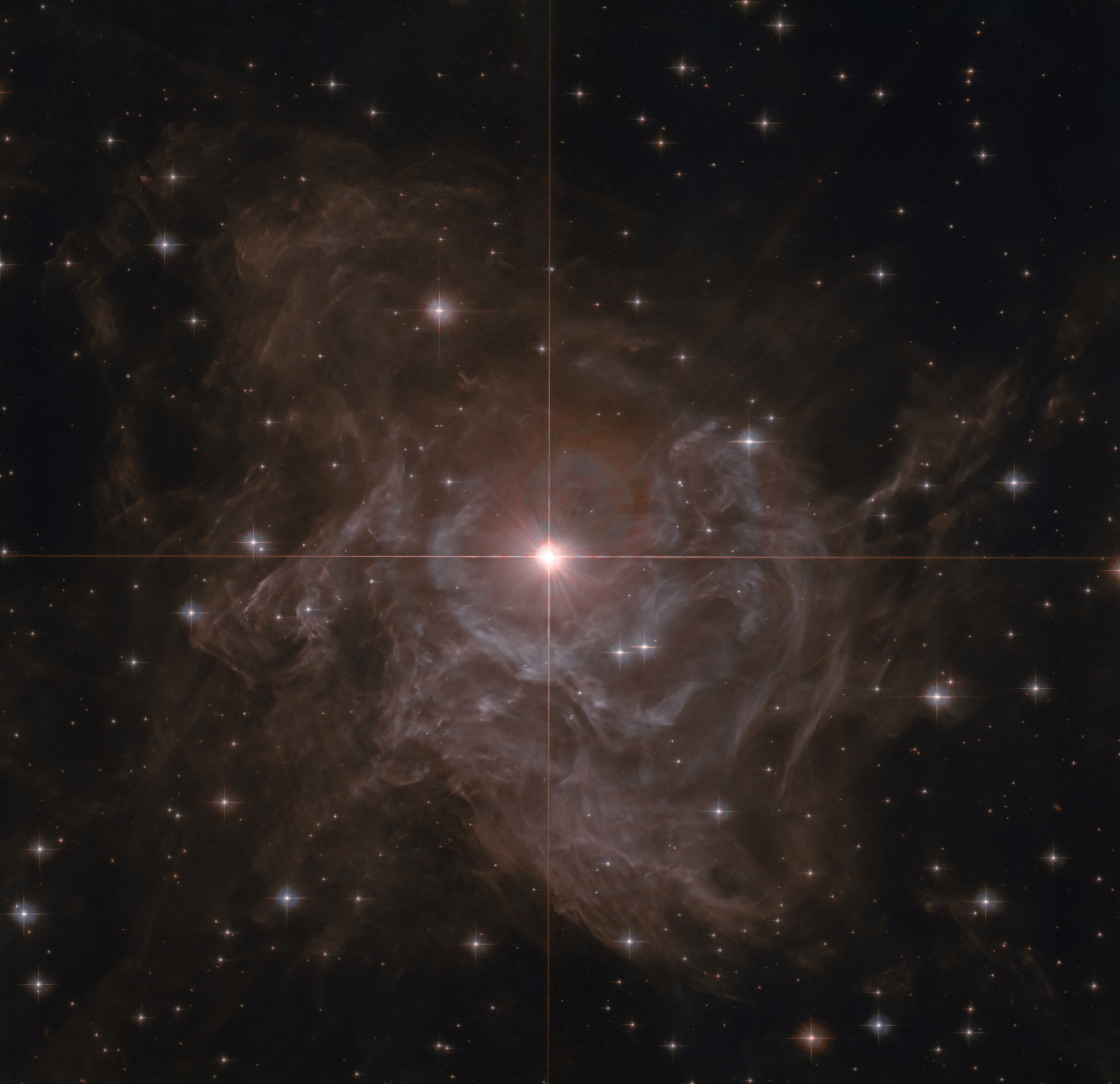
Nearby Cepheid Variable RS Pup


Image Credit: Hubble Legacy Archive, NASA, ESA - Processing: Stephen Byrne

Explanation: It is one of the most important stars in the sky. This is partly because, by coincidence, it is surrounded by a dazzling reflection nebula. Pulsating RS Puppis, the brightest star in the image center, is some ten times more massive than our Sun and on average 15,000 times more luminous. In fact, RS Pup is a Cepheid type variable star, a class of stars whose brightness is used to estimate distances to nearby galaxies as one of the first steps in establishing the cosmic distance scale. As RS Pup pulsates over a period of about 40 days, its regular changes in brightness are also seen along the nebula delayed in time, effectively a light echo. Using measurements of the time delay and angular size of the nebula, the known speed of light allows astronomers to geometrically determine the distance toRS Pup to be 6,500 light-years, with a remarkably small error of plus or minus 90 light-years. An impressive achievement for stellar astronomy, the echo-measured distance also more accurately establishes the true brightness of RS Pup, and by extension other Cepheid stars, improving the knowledge of distances to galaxies beyond the Milky Way. The above image was taken by the Hubble Space Telescope and digitally processed by a volunteer.

2013 September 9

samedi 7 septembre 2013

The solar system moves through a local galactic cloud at a speed of 50,000 miles per hour

Click for high-res version


The solar system moves through a local galactic cloud at a speed of 50,000 miles per hour, creating an interstellar wind of particles, some of which can travel all the way toward Earth to provide information about our neighborhood.

Image Credit: NASA/Adler/U. Chicago/Wesleyan.

(via Eleven Spacecraft Show Interstellar Wind Changed Direction Over 40 Years)

Posted on September 6, 2013

Source: nasa.gov

http://science-junkie.tumblr.com/post/60457598573/the-solar-system-moves-through-a-local-galactic#.UisO_dJLPSk

How Old Are They?

Rains on different worlds

La frontière entre planète et étoile s’efface

Une naine brune n'est ni une étoile, ni une planète,
mais un astre entre les deux. Crédit : NASA/JPL-Caltech
Les naines brunes les plus froides ont une masse située entre 5 et 20 fois celle de Jupiter, selon une nouvelle étude. Elles feraient ainsi le lien entre les planètes géantes et les étoiles plus chaudes.

Une naine brune est un astre qui n'atteint pas 80 fois la masse de Jupiter, nécessaire pour entretenir la fusion de l'hydrogène comme dans le cœur d'une étoile.

La limite inférieure avec les planètes est habituellement fixée à 13 masses joviennes, une masse qui est suffisante pour brûler du deutérium. Mais cette séparation n'est pas nette.

Des petites étoiles froides

En mesurant précisément la distance d'un grand nombre de naines brunes grâce au télescope infrarouge Spitzer, des astronomes ont calculé leurtempérature de surface. Comprises entre 125 et 175°C, ces températures restent les plus froidesjamais mesurées pour ce type d'astres, mais sont plus élevées que ce que les modèles prédisent.

Pour atteindre ces températures après un refroidissement de plusieurs milliards d'années, ces objets doivent avoir une masse entre 5 et 20 fois celle de Jupiter. Ce sont donc les meilleurs analogues aux exoplanètes géantes.

La formation plutôt que la masse comme critère ?

La frontière entre ces étoiles froides et les planètes devient donc encore un peu plus floue.

Si une naine brune avait été observée en orbite autour d'une étoile, elle aurait sûrement été classée parmi les planètes. Mais les astronomes pensent qu'elles sont apparues de façon isolée, et non dans le disque d'accrétion d'une étoile massive. Ce critère pourrait se révéler plus pertinent, si les modèles de formation se précisent.

Sylvain Guilbaud, le 6 septembre 2013

http://www.cieletespace.fr/node/10872

MUSE observera les débuts de l'Univers

Le projet MUSE permettra de scruter les régions les plus lointaines de l'Univers, c'est à dire d'observer les premier instants de l'Univers, quand la matière s'assemble en étoiles et en galaxies.

MUSE doit permettre de comprendre comment l'Univers, formé il y a environ 13 milliards d'années, s'est organisé en étoiles et en galaxies il y a environ 12 milliards d'années. Pour observer les Galaxies à leur création, il faut observer les plus lointaines d'entre elles, celles dont la lumière est la plus faible, car elle vient de loin à travers l'espace qu'elle traverse depuis 12 milliards d'années.

Ces galaxies sont des millions de fois moins lumineuses que les étoiles ou galaxies que nous pouvons voir à l'oeil nu. Il faut donc un instrument très sensible pour capter la moindre lumière. En raison de l'expansion de l'Univers, cette lumière est décalée vers l'infrarouge, ce qui la rend encore plus difficile à capter.

MUSE permettra d'étudier les plus jeunes des galaxies dont les étoiles sont très lumineuses. Leur lumière trahit la présence dominante d'hydrogène l'élément le plus abondant de l'Univers. MUSE pourra isoler les raies de longueur d'onde de l'hydrogène de ces étoiles et permettra d'étudier les galaxies.

MUSE pourra explorer des amas de galaxies lontains, les milieux intergalatique, des amais globulaires, des trous noirs gérants au centre de galaxies. MUSE permetrta d'étudier de petites corps du système solaire.

Des systèmes pour améliorer les images déformées par l'atmosphère

Pour observer des régions lointaines de l'Univers, MUSE est composé de 24 modules constitués chacun de centaines d'élements optiques et mécaniques de grande précision qui ont été assemblés dans une salle blanche aménagée dans une halle construite sur le site de l'Observatoire de Lyon, à Saint Genis Laval.

Le système est constitué de quatre étoiles laser et d'un grand miroir déformable dont la surface peut être corrigée par 1000 actuateurs capables d'améliorer la qualité des informations reçues. Les déformations entrainées par les perturbations de l'atmosphère sont corrigées afin de livrer des données fiables.

MUSE est prêt à partir de Lyon. Démonté puis ré-assemblé sur la plate forme Nasmyth de Yepun (Vénus en langue Mapuche) l'un des quatre télescopes de 8,4 mètres de diamètres du site de Paranal, dans le désert d'Atacama. Une fois réalisés les contrôles et la mise en service au moment de la " première lumière", l'instrument pourra être utilisé par des équipes d'astronomes du monde entier. Les premiers résultats arriveront dans plusieurs années. MUSE devrait être en service pendant une vingtaine d'années.

vendredi 23 août 2013

La spectaculaire naissance d'une étoile

La très impressionnante naissance d'une étoile a été capturée par l'observatoire ALMA, dans le désert d'Atacama au Chili.

1/4La naissance d'une étoile a été capturée par l'observatoire ALMA.
Image: ESO/ALMA /Keystone

Elle s’est formée à plus de 1400 années-lumière de la Terre, et s’appelle Herbig-Haro 46/47. La naissance de cette toute nouvelle étoile de la constellation australe de Véla a été capturée parl’observatoire ALMA.

Utilisant le Grand Réseau d’Antennes (sub)millimétrique de l’Atacama (ALMA) au Chili, les astronomes ont obtenu de rares images de matière s’échappant de l’étoile qui venait de se former, explique l’observatoire sur son site. Il s’agit certainement des images de naissance d'étoile les plus précises jamais enregistrées.

Stuartt Corder, l'un des co-auteurs de cette nouvelle étude, en est encore abasourdi: «Le niveau de détail qui caractérise les images de Herbig-Haro 46/47 est stupéfiant. D'autant plus impressionnant que ces images ont été acquises lors de la première phase d'exploitation scientifique d'ALMA. Dans l'avenir, ALMA procurera des images encore meilleures que celles-ci en une fraction de temps.»

Grâce à ses capteurs hypersensibles, ALMA a pu enregistrer deux mouvements de molécules de monoxyde de carbone éjectées dans l’espace à un million de km/h. En entrant en contact avec le gaz environnant, cette matière émet une lueur colorée, détectée par le télescope. Deux jets ont pu être observés. L’un se déplaçant en direction de la Terre et un autre, qui jusqu’ici était invisible, dans le sens contraire.

Par Aurore Boullé

mercredi 21 août 2013

Milky Way Shows 84 Million Stars in 9 Billion Pixels


The two images shown above are mere crop outs from ESA’s recent hit: The 9 Billion Pixel Image of 84 Million Stars. These two focus on the bright center of the image for the purpose of highlighting what a peak at 84,000,000 stars looks like.

Astronomers at the European Southern Observatory’s Paranal Observatory in Chile have released a breathtaking new photograph showing the central area of our Milky Way galaxy. The photograph shows a whopping 84 million stars in an image measuring 108500×81500, which contains nearly 9 billion pixels.

It’s actually a composite of thousands of individual photographs shot with the observatory’s VISTA survey telescope, the same camera that captured the amazing 55-hour exposure. Three different infrared filters were used to capture the different details present in the final image.

The VISTA’s camera is sensitive to infrared light, which allows its vision to pierce through much of the space dust that blocks the view of ordinary optical telescope/camera systems.

source

http://kenobi-wan-obi.tumblr.com/post/58828543475/kenobi-wan-obi-milky-way-shows-84-million-stars

dimanche 18 août 2013

Earthshine


This beautiful phenomenon is called Earthshine. The soft glow on the shadowed part of the moon is caused by the reflection of sunlight from the Earth.

Specifically, Earthshine happens when the light from the Sun is reflected from the Earth’s surface, to the moon, and then back to our eyes. Because of this double reflection of light, Earthshine is many times dimmer than the direct light of the Sun on the Moon.
Earthshine can be best seen during the crescent phases (the 1-5 day period before or after a New Moon).

(Source: knowledgethroughscience)

http://knowledgethroughscience.tumblr.com/post/58611093022/this-beautiful-phenomenon-is-called-earthshine

Au Coeur De La Voie Lactée

"Au Coeur De La Voie Lactée" est un sublime documentaire récemment diffusé sur la chaîne Arte, qui retrace l'histoire de notre galaxie depuis le Big Bang jusqu'à nos jours.


mardi 13 août 2013

What Is A Quasar ?


I love it when scientists discover something unusual in nature. They have no idea what it is, and then over decades of research, evidence builds, and scientists grow to understand what’s going on.

My favorite example? Quasars.

Astronomers first knew they had a mystery on their hands in the 1960s when they turned the first radio telescopes to the sky.


They detected the radio waves streaming off the Sun, the Milky Way and a few stars, but they also turned up bizarre objects they couldn’t explain. These objects were small and incredibly bright.

They named them quasi-stellar-objects or “quasars”, and then began to argue about what might be causing them. The first was found to be moving away at more than a third the speed of light.

But was it really?


An artist’s conception of jets protruding from an AGN.

Maybe we were seeing the distortion of gravity from a black hole, or could it be the white hole end of a wormhole. And If it was that fast, then it was really, really far… 4 billion light years away. And it generating as much energy as an entire galaxy with a hundred billion stars.

What could do this?

Here’s where Astronomers got creative. Maybe quasars weren’t really that bright, and it was our understanding of the size and expansion of the Universe that was wrong. Or maybe we were seeing the results of a civilization, who had harnessed all stars in their galaxy into some kind of energy source.

Then in the 1980s, astronomers started to agree on the active galaxy theory as the source of quasars. That, in fact, several different kinds of objects: quasars, blazars and radio galaxies were all the same thing, just seen from different angles. And that some mechanism was causing galaxies to blast out jets of radiation from their cores.

But what was that mechanism?


This artist’s concept illustrates a quasar, or feeding black hole, similar to APM 08279+5255,
where astronomers discovered huge amounts of water vapor. Gas and dust likely form a torus
around the central black hole, with clouds of charged gas above and below.
Image credit: NASA/ESA


We now know that all galaxies have supermassive black holes at their centers; some billions of times the mass of the Sun. When material gets too close, it forms an accretion disk around the black hole. It heats up to millions of degrees, blasting out an enormous amount of radiation.

The magnetic environment around the black hole forms twin jets of material which flow out into space for millions of light-years. This is an AGN, an active galactic nucleus.


When the jets are perpendicular to our view, we see a radio galaxy. If they’re at an angle, we see a quasar. And when we’re staring right down the barrel of the jet, that’s a blazar. It’s the same object, seen from three different perspectives.

Supermassive black holes aren’t always feeding. If a black hole runs out of food, the jets run out of power and shut down. Right up until something else gets too close, and the whole system starts up again.

The Milky Way has a supermassive black hole at its center, and it’s all out of food. It doesn’t have an active galactic nucleus, and so, we don’t appear as a quasar to some distant galaxy.

We may have in the past, and may again in the future. In 10 billion years or so, when the Milky way collides with Andromeda, our supermassive black hole may roar to life as a quasar, consuming all this new material.

If you’d like more information on Quasars, check out NASA’s Discussion on Quasars, and here’s a link to NASA’s Ask an Astrophysicist Page about Quasars.

We’ve also recorded an entire episode of Astronomy Cast all about Quasars Listen here, Episode 98: Quasars.

Sources: UT-Knoxville, NASA, Wikipedia

by FRASER CAIN on AUGUST 12, 2013

Read more: http://www.universetoday.com/73222/what-is-a-quasar/#ixzz2bqmXTpxU

vendredi 9 août 2013

Why Do Stars Twinkle?


Did you know you can distinguish between stars and planets in the sky?

Stars twinkle, planets don’t.

Okay, that’s not actually correct. The stars, planets, even the Sun and Moon twinkle, all in varying amounts. Anything outside the atmosphere is going to twinkle.

If you’re feeling a little silly using the word twinkle over and over again, we can also use the scientific term: astronomical scintillation.

You can’t feel it, but you’re carrying the entire weight of the atmosphere on your shoulders. Every single square inch of your skin is getting pushed by 15 pounds of pressure. And even though astronomers need our atmosphere to survive, it still drives them crazy. As it makes objects in space so much harder to see.

Stars twinkle, I mean scintillate, because as light passes down through a volume of air, turbulence in the Earth’s atmosphere refracts light differently from moment to moment. From our perspective, the light from a star will appear in one location, then milliseconds later, it’ll be distorted to a different spot.

We see this as twinkling.

So why do stars appear to twinkle, while planets don’t?

Stars appear as a single point in the sky, because of the great distance between us and them. This single point can be highly affected by atmospheric turbulence. Planets, being much closer, appear as disks.

We can’t resolve them as disks with our eyes, but it still averages out as a more stable light in the sky.

Astronomers battle atmospheric turbulence in two ways:


Hubble Against Earth’s Horizon (1997)

First, they try to get above it. The Hubble Space Telescope is powerful because it’s outside the atmosphere. The mirror is actually a quarter the size of a large ground-based observatory, but without atmospheric distortion, Hubble can resolve galaxies billions of light-years away. The longer it looks, the more light it gathers.

Second, they try to compensate for it.

Some of the most sophisticated telescopes on Earth use adaptive optics, which distorts the mirror of the telescope many times a second to compensate for the turbulence in the atmosphere.


A beam from the Laser Star Guide on one of the VLT’s four Unit Telescopes helps to correct
the blurring effect of Earth’s atmosphere before making observations (ESO/Y. 
Beletsky)

Astronomers project a powerful laser into the sky, creating an artificial star within their viewing area. Since they know what the artificial star should look like, they distort the telescope’s mirror with pistons cancelling out the atmospheric distortion. While it’s not as good as actually launching a telescope into space, it’s much, much cheaper.

Now you know why stars twinkle, why planets don’t seem to twinkle as much, and how you can make all of them stop.

by FRASER CAIN on AUGUST 8, 2013

Read more: http://www.universetoday.com/25345/why-do-stars-twinkle/#ixzz2bTGqKFe7