Affichage des articles dont le libellé est Physique. Afficher tous les articles

jeudi 10 octobre 2013

Celebrating Crystallography - An animated adventure


One of the great innovations of the twentieth century is likely not well-known, but this video from the Ri Channel is looking to change that:

This is X-ray crystallography.

Discovered in 1913 by William and Lawrence Bragg, x-ray crystallography is a technique that reveals the atomic and molecular structure of a crystal. When a narrow beam of x-rays is shown through the crystal, it diffracts into a pattern of rays through the other side.

"To date 28 Nobel Prizes have been awarded to projects related to the field" and 100 years after its discovery, the Curiosity Rover is using x-ray crystallography to analyze soil on Mars.

Science! And if you haven’t seen these yet, we’ve shared some of our favorite science videos for kids over at RiChannel.org, where they know great science videos.

53 MINUTES AGO

mercredi 2 octobre 2013

Casimir Force Reduced to Lowest Recorded Level through metallic surface nanostructuring

A research team that includes a physics professor at Indiana University-Purdue University Indianapolis (IUPUI) has recorded a drastically reduced measurement of the Casimir effect, a fundamental quantum phenomenon experienced between two neutral bodies that exist in a vacuum.

The experiment revealed the Casimir pressure was reduced at more than twice the expected levels when the sphere and the grating surface were separated from one another by up to 500 nanometers.


Nature Communication - Strong Casimir force reduction through metallic surface nanostructuring

The Casimir force between bodies in vacuum can be understood as arising from their interaction with an infinite number of fluctuating electromagnetic quantum vacuum modes, resulting in a complex dependence on the shape and material of the interacting objects. Becoming dominant at small separations, the force has a significant role in nanomechanics and object manipulation at the nanoscale, leading to a considerable interest in identifying structures where the Casimir interaction behaves significantly different from the well-known attractive force between parallel plates. Here we experimentally demonstrate that by nanostructuring one of the interacting metal surfaces at scales below the plasma wavelength, an unexpected regime in the Casimir force can be observed. Replacing a flat surface with a deep metallic lamellar grating with sub-100 nm features strongly suppresses the Casimir force and for large inter-surfaces separations reduces it beyond what would be expected by any existing theoretical prediction.

POSTED BY BRIAN WANG AT 10/01/2013

lundi 16 septembre 2013

Graphene could yield cheaper optical chips

In a new graphene-on-silicon photodetector, electrodes (gold) are deposited, slightly asymmetrically, on either side of a silicon waveguide (purple). The asymmetry causes electrons kicked free by incoming light to escape the layer of graphene (hexagons) as an electrical current. Credit: RESEARCHERS


Graphene—which consists of atom-thick sheets of carbon atoms arranged hexagonally—is the new wonder material: Flexible, lightweight and incredibly conductive electrically, it's also the strongest material known to man.

In the latest issue of Nature Photonics, researchers at MIT, Columbia University and IBM's T. J. Watson Research Center describe a promising new application of graphene, in the photodetectors that would convert optical signals to electrical signals in integrated optoelectronic computer chips. Using light rather than electricity to move data both within and between computer chips could drastically reduce their power consumption and heat production, problems that loom ever larger as chips' computational capacity increases.

Optoelectronic devices built from graphene could be much simpler in design than those made from other materials. If a method for efficiently depositing layers of graphene—a major area of research in materials science—can be found, it could ultimately lead to optoelectronic chips that are simpler and cheaper to manufacture.

"Another advantage, besides the possibility of making device fabrication simpler, is that the high mobility and ultrahigh carrier-saturation velocity of electrons in graphene makes for very fast detectors and modulators," says Dirk Englund, the Jamieson Career Development Assistant Professor of Electrical Engineering and Computer Science at MIT, who led the new research.

Graphene is also responsive to a wider range of light frequencies than the materials typically used in photodetectors, so graphene-based optoelectronic chips could conceivably use a broader-band optical signal, enabling them to move data more efficiently. "A two-micron photon just flies straight through a germanium photodetector," Englund says, "but it is absorbed and leads to measurable current—as we actually show in the paper—in graphene."

Unbiased account

As Englund explains, the problem with graphene as a photodetector has traditionally been its low responsivity: A sheet of graphene will convert only about 2 percent of the light passing through it into an electrical current. That's actually quite high for a material only an atom thick, but it's still too low to be useful.

When light strikes a photoelectric material like germanium or graphene, it kicks electrons orbiting atoms of the material into a higher energy state, where they're free to flow in an electrical current. If they don't immediately begin to move, however, they'll usually drop back down into the lower energy state. So one standard trick for increasing a photodetector's responsivity is to "bias" it—to apply a voltage across it that causes the electrons to flow before they lose energy.

The problem is that the voltage will inevitably induce a slight background current that adds "noise" to the detector's readings, making them less reliable. So Englund, his student Ren-Jye Shiue, Columbia's Xuetao Gan—who, together with Shiue, is lead author on the paper—and their collaborators instead used a photodetector design developed by Fengnian Xia and his colleagues at IBM, which produces a slight bias without the application of a voltage.

In the new design, light enters the detector through a silicon channel—a "waveguide"—etched into the surface of a chip. The layer of graphene is deposited on top of and perpendicular to the waveguide. On either side of the graphene layer is a gold electrode. But the electrodes' placement is asymmetrical: One of them is closer to the waveguide than the other.

"There's a mismatch between the energy of electrons in the metal contact and in graphene," Englund says, "and this creates an electric field near the electrode." When electrons are kicked up by photons in the waveguide, the electric field pulls them to the electrode, creating a current.

Hot topic

In experiments, the researchers found that, unbiased, their detector would generate 16 milliamps of current for each watt of incoming light. Its detection frequency was 20 gigahertz—already competitive with germanium. (Some experimental germanium photodetectors have achieved higher speeds, but only when biased.) With the application of a slight bias, the detector could get up to 100 milliamps per watt, a responsivity commensurate with that of germanium.

Englund is confident that better engineering—thinner electrodes, or a narrower waveguide—could yield a photodetector whose responsivity is even higher. "It's a matter of engineering," he says. "We are already testing some new tricks to get another factor of two or four."

"I think it's great work," says Thomas Mueller, an assistant professor at the Vienna University of Technology's Photonics Institute. "The main drawback of graphene photodetectors was always their low responsivity. Now they have two orders of magnitude higher responsivity, which is really great."

"The other thing that I like very much is the integration with a silicon chip," Mueller adds, "which really shows that, in the end, you'll be able to integrate graphene into computer chips to realize optical links and things like that."

In fact, the same issue of Nature Photonics also features a paper by Mueller and colleagues, reporting work very similar to that conducted by Englund and his team. "We did not know that we were doing the same thing," Mueller says. "But I'm very happy that two papers are coming out in the same journal on the same topic, which shows that it's an important thing, I think."

The chief difference between the two groups' work, Mueller says, is that "we used slightly different geometry." But, he adds, "Honestly, I think that Dirk's geometry is more practical. We were also thinking about the same thing, but we didn't have the technical capabilities to do this. There's one process that they do that we were not able to do."

Journal reference: Nature Photonics

Provided by Massachusetts Institute of Technology

September 16, 2013

24 minutes ago by Larry Hardesty

Read more at: http://phys.org/news/2013-09-graphene-yield-cheaper-optical-chips.html#jCp

dimanche 25 août 2013

What Is a Field?


Contributing editor George Musser explains how physicists think about the universe using the fundamental concept of "the field".

Jun 19, 2013

http://www.scientificamerican.com/video.cfm?id=what-is-a-field2013-06-19

lundi 19 août 2013

Why is the sky blue?


It is easy to see that the sky is blue. Have you ever wondered why? A lot of other smart people have, too. And it took a long time to figure it out!

The light from the Sun looks white. But it is really made up of all the colors of the rainbow.


A prism is a specially shaped crystal. When white light shines through a prism, the light is separated into all its colors.

The light from the Sun looks white. But it is really made up of all the colors of the rainbow.

If you visited The Land of the Magic Windows, you learned that the light you see is just one tiny bit of all the kinds of light energy beaming around the Universe--and around you!

Like energy passing through the ocean, light energy travels in waves, too. Some light travels in short, "choppy" waves. Other light travels in long, lazy waves. Bluelight waves are shorter than red light waves.


All light travels in a straight line unless something gets in the way to—
  • reflect it (like a mirror)
  • bend it (like a prism)
  • or scatter it (like molecules of the gases in the atmosphere)

Sunlight reaches Earth's atmosphere and is scattered in all directions by all the gases and particles in the air. Blue light is scattered in all directions by the tiny molecules of air in Earth's atmosphere. Blue is scattered more than other colors because it travels as shorter, smaller waves. This is why we see a blue sky most of the time.


Closer to the horizon, the sky fades to a lighter blue or white. The sunlight reaching us from low in the sky has passed through even more air than the sunlight reaching us from overhead. As the sunlight has passed through all this air, the air molecules have scattered and rescattered the blue light many times in many directions. Also, the surface of Earth has reflected and scattered the light. All this scattering mixes the colors together again so we see more white and less blue.

What Makes a Red Sunset?

As the Sun gets lower in the sky, its light is passing through more of the atmosphere to reach you. Even more of the blue light is scattered, allowing the reds and yellows to pass straight through to your eyes.


Sometimes the whole western sky seems to glow. The sky appears red because larger particles of dust, pollution, and water vapor in the atmosphere reflect and scatter more of the reds and yellows.

http://spaceplace.nasa.gov/blue-sky/

dimanche 18 août 2013

A Brief Animated History of Physics


What we've learned is always interesting, but how we learned it is a great story as well. A cute animated video from the BBC Science Club tells us how the study of physics has evolved. (via Geeks Are Sexy)

Sunday, August 18, 2013

mardi 13 août 2013

Secret Of Graphene Revealed: It’s A Total Diva


A team at Lawrence Berkeley National Laboratory has just announced a new breakthrough in the field of graphene research, leading to the next generation of high-efficiency solar cells, computers and other advanced technologies. Graphene, a new material that was discovered less than 10 years ago, is an ultra-thin, superstrong, superflexible electron conductor. As for how to explain the Berkeley Lab research in lay terms, let’s just say that if graphene had a personality it would have its own reality show, and it would give Total Divasa run for the money.

No, seriously. Researchers have already demonstrated that graphene possesses an outsized talent for showing off its unique properties, which is surely one prerequisite for diva-ness. The other is a highly developed sensitivity to minor irritations, and that is the focus of the new Berkeley Lab research.

A Graphene Mystery

To understand the significance of the Berkeley Lab breakthrough, let’s start at the beginning. Graphene consists of a sheet of carbon only one atom thick, with a distinctive lattice structure similar to chicken wire.


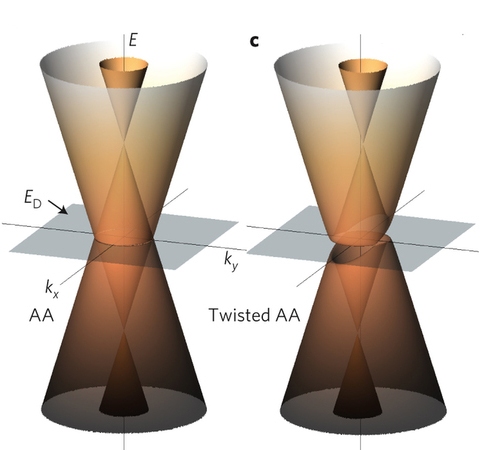
Dirac spectrum in bilayer graphene courtesy of LBL.

On the plus side, graphene is an extremely efficient conductor, far more efficient than silicon. However, this is where graphene’s diva side kicks in. To translate graphene into on/off devices, you need to be able to switch off the conduction, and graphene simply refuses to shut itself down completely.

The basic problem is that a single sheet of graphene has no range of energy that prohibits electrons from existing. Called a bandgap, this range is essential for controlling the electron current.

Berkeley Lab researchers previously attempted to work around the problem by using two layers of graphene to create a bandgap. However, when the bilayer graphene was incorporated into devices it flopped. The devices acted as if the graphene was a single layer, with no bandgap.

Mystery, Solved!

Picking apart that phenomenon is the next critical phase in the research, and that is where the new Berkeley Lab research project comes in.

Using the Lab’s Advanced Light Source, they subjected the bilevel graphene to a beam of X-ray photons. That analytic tool produces a snapshot of the material’s electronic spectrum.

The results were surprising. In contrast to what the team had assumed, the spectrum contained extra branches. These consisted of massless Dirac fermions, which are electrons that behave like photons (named after U.K. physicist Paul Dirac). Since Dirac fermions do not follow the same bandgap rules as normal electrons, that explains why the bilayer graphene had no “on-off” switch.

The team traced the creation of massless Dirac fermions to atomic-level misalignments between the two layers of graphene. While almost imperceptible, the misalignment creates a “twist” in the material that generates the massless Dirac fermions.

The bad news is, the problem is not easily resolved. The team estimates that just ten atomic “misfits” per square micron are enough to throw the whole thing off.

However, the team anticipates that the results will guide it to the next step in the research. Lead author of the study Keun Su Kim explains:

Now that we understand the problem, we can search for solutions. For example, we can try to develop fabrication techniques that minimize the twist effects, or reduce the size of the bilayer graphene we make so that we have a better chance of producing locally pure material…

Kim also sees the study applying across the field of graphene research:

A lesson learned here is that even such a tiny structural distortion of atomic-scale materials should not be dismissed in describing the electronic properties of these materials fully and accurately.

More Exciting News About Graphene

As mentioned above, graphene has only been around since 2004, when a U.K. research team literally lifted a layer of atoms from the surface of a chunk of graphite with sticky tape, but the topic has already generated thousands of research papers as scientists race to unlock the mysteries of its unique properties.

Among the many recent developments, researchers are beginning to identify materials that mimic graphene’s more desirable properties, while being more capable of taking direction and put up with minor irregularities. A team at Columbia University, for example, used boron nitride (aka “white graphene”) to create the rare “Hofstadter butterfly” fractal pattern (a fractal pattern repeats itself in smaller and smaller shapes).

A research team in Spain went even farther afield, finding that they could develop an acoustic analog for graphene simply by drilling holes in a sheet of plastic.

As for why CleanTechnica is so interested in graphene (see our numerous posts on the topic), photovoltaic cells are among the many devices that could be looking at an ultra-efficient graphene future.

Published on August 13th, 2013 | by Tina Casey

jeudi 8 août 2013

Podcast: The Inverse-Square Law and Other Strangeness


Why don’t we have insects the size of horses? Why do bubbles form spheres? Why does it take so much energy to broadcast to every star? Let’s take a look at some non-linear mathematical relationships and see how they impact your day-to-day life.

Click here to download the episode.

Or subscribe to: astronomycast.com/podcast.xml with your podcatching software.

“Inverse-Square Law and Other Strangeness” on the Astronomy Cast website, with shownotes and transcript.

And the podcast is also available as a video, as Fraser and Pamela now record Astronomy Cast as part of a Google+ Hangout (usually recorded every Monday at 3 pm Eastern Time):


lundi 5 août 2013

Galileo’s Secret Telescope Technology Revealed

Galileo could not have built the world’s first astronomical telescope without a revolutionary new theory of optics that he must have kept secret, argue historians of science


The Renaissance physicist, mathematician, philosopher and astronomer Galileo Galilei is perhaps best known for his work on gravity, relative motion and the discovery of numerous astronomical objects such as Jupiter’s four largest moons, the phases of Venus and so on.

But just as remarkable is Galileo’s work as an optical engineer on the design of the telescope. Galileo didn’t invent the telescope but he did adapt the design of the spyglass for astronomical purposes.

In fact, Galileo’s improvements were extraordinary. Between the summer 1609 and the beginning of January 1610, Galileo increased the magnification of his telescope by a factor of 21. He also introduced a number of modifications, such as the ability to control its aperture, that helped to reduce optical aberrations.

It was these changes that turned an ordinary spyglass into a revolutionary astronomical instrument.

So an interesting question is to ask what theory of optics Galileo used to make these advances. The standard view is that Galileo’s improvements were an educated extrapolation of the optical ideas used to design spectacles.

But today, Yaakov Zik and Giora Hon at the University of Haifa in Israel say that Galileo’s understanding of optics must have been much more detailed than that of a standard spectacle-maker. Indeed, they argue that the improvements Galileo made to the telescope could only have been possible with a new theory of optics as revolutionary as the device itself.

Galileo first published his astronomical discoveries in March 1610 in a pamphlet called Siderus Nuncius. At the beginning of the leaflet, Galileo described the properties a good astronomical telescope should have and attempted to convince his readers of the reliability of his observations by describing how its optical performance could be calibrated.

In doing this, Galileo reveals the extraordinary depth of his optical knowledge, say Zik and Hon. For example, he was able to calculate the magnification of his telescope and modify its aperture to minimise aberrations.

He had a focus shift that adjusted the length of the telescope showing that he was aware of the optical power of lenses which he linked to their “lengths”.

He also defined and calculated the apparent field of view of his telescope and used this to measure angular distances between celestial bodies.

Zik and Hon spend some time discussing these new features in the context of the optical technology of the time. “Could these great achievements be accomplished by extending [traditional] optics of the spectacle makers in a lightly theorized practice based on “systematized experience”?, they ask.

Their answer is unequivocal. “We think not.” Instead they argue that Galileo must have had had a much deeper understanding of optics. “We submit that Galileo had a novel optical theory which he did not want to divulge, but his practice and the extant instruments display it,” they say.

That’s an interesting conclusion that testifies to Galileo’s remarkable achievement. But we’ll almost certainly never know what Galileo’s optical theory consisted of—he never published his ideas in this area.

However, it’s not beyond belief that he stood head and shoulders above his peers in this respect, as in many others. There are certainly many individuals in history who have made great strides beyond the state-of-the-art of the time. Zik and Hon’s work show that Galileo is clearly one of them.

Ref: arxiv.org/abs/1307.4963 : Galileo’s Knowledge Of Optics And The Functioning Of The Telescope

August 5, 2013

lundi 22 juillet 2013

Dans l’espace, les microstructures se solidifient de façon oscillante

Une expérience menée dans la station spatiale internationale a révélé une dynamique oscillante de la solidification d’un alliage.

Impossible de mener cette expérience sur le sol terrestre. Dans le cas d’alliages, les différences de masse entre les constituants génère de la convection de masse. Cela modifie la concentration dans le soluté, l’interface solide-liquide se courbe, faisant dériver les cellules du bord vers le centre et les empêchant d’avoir leur dynamique propre.

Il aura donc fallu la mise en place d’un instrument spécifique, DECLIC (dispositif d’Etude de la Croissance et des LIquides Critiques), pour pouvoir espérer observer cette solidification avec sa dynamique non parasitée par la gravité. Parmi les différents modules existants, le module DSI (Directional Solidification Insert) est dédié à l’observation des microstructures qui se forment à l’interface liquide-solide lors de lasolidification d’un matériau transparent. Un dispositif permettant le suivi en temps réel et in situ du phénomène. C’est ainsi que des physiciens de l’Institut matériaux microélectronique et nanosciences de Provence (CNRS/AMU/ Université du Sud Toulon - Var) ont pu analyser les modes de croissance de ces microstructures.

Ils ont étudié du succinonitrile, une molécule organique à laquelle ils ont ajouté du camphre. Travailler sur cet alliage transparent présente plusieurs avantages : possibilité d’observation directe optique, une température de fusion basse facile à atteindre, un comportement semblable aux alliage métallique ce qui en fait un alliage modèle.

Publiés dans Physical Review Letters, leurs travaux montrent une structure cellulaire possédant une dynamique oscillante, les cellules se dilatent puis se rétractent de façon périodique ! Du fait du désordre intrinsèque au réseau, cette solidification oscillante est aléatoire d’une cellule à l’autre. Globalement, si l’on considère la totalité du front, les oscillations sont désordonnées. Mais localement, il arrive que plusieurs cellules s’ordonnent entre elles pour former un réseau régulier. Dès lors, bien que chaque réseau soit indépendant et respire sans arrêt, leurs oscillations s’organisent entre elles. C’est ce que les chercheurs ont pu observer sur un réseau hexagonal où trois sous-réseaux oscillent avec un déphasage de 120°. « Prenons l’exemple d ‘un hexagone. Un sommet sur deux est à son maximum, un sommet sur deux à son minimum, et la cellule au centre est entre les deux » explique Jean-Marc Debierre, en charge des calculs sur ce projet. « Nous avions prédit l’existence de ces oscillations depuis longtemps et ce déphasage de 2π/3, mais sans savoir si nous pourrions les observer un jour. Nous avons eu un coup de chance. » se réjouit Jean-Marc Debierre, professeur à l’université d’Aix-Marseille.

Découvrez cette dynamique oscillante :

Le projet DECLIC-DSI a été installé dans la Station Spatiale Internationale dans le but d’éliminer les perturbations liées à la convection puis téléopéré depuis le centre des opérations en vol CADMOS à Toulouse. Le projet DECLIC-DSI est issu d'une collaboration entre des chercheurs de l'IM2NP (UMR CNRS 7334, Université d'Aix-Marseille), de Northeastern University (Boston) et de Iowa State University (Ames). Il est soutenu par la région PACA.


Simulation numérique (en accéléré) où se produit une mise en ordre hexagonal du réseau cellulaire et une oscillation de type 2pi/3

Par Audrey Loubens, journaliste scientifique

22 juil. 2013

http://www.techniques-ingenieur.fr/actualite/chimie-thematique_6343/dans-l-espace-les-microstructures-se-solidifient-de-facon-oscillante-article_83755/

samedi 13 juillet 2013

The Story of Physics


If you want a brief history of physics (hopefully in animated form) then you have come to the right place. This very cool video directed by Åsa Lucander and narrated by Dara O Briain gives you a pithy and humorous take on what has happened so far.

From Galileo through Newton to Einstein and beyond The Story of Physics gives you (almost) everything you ever wanted to know but were way too bored at school to ask… There's even a cameo by that darned cat...

Saturday, July 13, 2013

samedi 25 mai 2013

What is the Higgs Boson? An Animated Explanation


So, here it is – everything you ever wanted to know about the Higgs Boson but were way too intimidated by the science to ask. Particle physics is something of a mystery to me and so it was great to watch this animation and be able to get something of a grasp on the Higgs Boson and what it actually is (and isn’t). This is (I am guessing!) a simplified explanation of what the Higgs Boson is and why it is so important (nothing would exist if it didn’t, effectively!).

This animation was created by James Sutton for part of his final year studying graphic design. The soundtrack is provided by christ. There has to be some irony in that.

Friday, May 24, 2013

http://www.kuriositas.com/2013/05/what-is-higgs-boson-animation.html?utm_source=feedburner&utm_medium=feed&utm_campaign=Feed%3A+Kuriositas+%28Kuriositas%29

lundi 14 mai 2012

EU physicists use 20 new satellites to forecast space weather

May 14, 2012

Photo: Yngve Vogt                   Enlarge          
The northern lights interfere with radio communications, GPS navigation and satellite communications. Researchers are now going to launch 20 satellites containing world class instruments from the University of Oslo to find out why.

Satellites are becoming increasingly important in communications and navigation. This makes us more vulnerable to the northern lights, especially within offshore and aviation. In a worst case scenario an aircraft can lose contact with its surroundings. Oil tankers can struggle with precise navigation.

In order to more precisely predict when radio communications and navigation will fail, researchers require more information about what happens when violent solar winds hit the Earth and produce the northern lights.

The solar winds consist of charged particles and produce powerful turbulence in theionosphere, which consists of plasma clouds with electrical particles at an altitude of 80 to 500 km. The turbulence interferes with radio signals. Sometimes they are reflected wrongly. On other occasions the signals are blocked altogether.

"In the northern regions GPS satellites lie low in the sky. This means the signals have to pass through the ionosphere. This reinforces the navigation problems," says professor Jøran Moen of the Department of Physics at University of Oslo (UiO), Norway.

Universities around the world are now working together to understand what is happening at a micro-level in the plasma clouds. When they have found the answers, the space experts will be able to forecast space weather, just like meteorologists forecast the Earth's weather every day.

UiO has developed very small instruments that can measure micro-structures and turbulence in the plasma clouds. The instrument consists of four needles that can be mounted on satellites about the size of a milk carton. No one else has managed this.

Unfortunately, a single satellite is not enough. It takes just over an hour and a half to orbit the Earth. This is far too long. The phenomena researchers are looking for often disappear after just an hour. Therefore, it is impossible to use a single satellite to study the changes over such a short time. The researchers need a lot of satellites, which will be spread around the Earth like pearls on a strong.

In 2013 the universities will work together to launch 50 small satellites into a polar orbit at an altitude of 320 km above the Earth. This will allow the satellites to pass each geographical point at intervals of just a few minutes, both above the polar regions and the equator.

The satellites will lose speed due to air resistance and their Earth orbits will continuously degrade.

This will provide the researchers with an opportunity to study all layers of the ionosphere. The calculated service life is three to eight weeks, depending on solar activity, before the satellites fall into the atmosphere and burn up.

The satellites are designed to be so small that they can all be launched on the same rocket. This is economical.

"20 of the satellites will concentrate on altitudes between 320 to 160 km. These satellites will be filled with our measuring instruments from UiO. This is the first fully Norwegian, scientific instrument in a satellite in history. That's fun!" says research fellow Tore André Bekkeng of the STAR Project at UiO.

Bekkeng developed the electronics, produced the super fast algorithms, and made everything as compact as possible to save as much power as possible. He is now looking for the most suitable materials with which to clad the super thin antennae that will measure electron density.

Both the ESA and NASA have shown great interest in UiO's instrumentation. NASA is also going to use the UiO invention in a rocket launch in Alaska in the spring.

Provided by University of Oslo (news : web)

http://phys.org/news/2012-05-eu-physicists-satellites-space-weather.html

Réflexion et réfraction de la lumière


Cet épisode fait partie du podcast Montrer de la physique
02 May 2012 13:28:21
Sylvie Zanier
6 min
98.34 Mo

La plus grosse erreur de toute l’histoire de la physique


En théorie, il n’y a pas de différence entre la théorie et la pratique. En pratique, il y en a une.

Aujourd’hui nous allons voir ce qui est, à ma connaissance, la plus grosse erreur jamais commise en physique théorique, au moins au sens quantitatif. Elle concerne l’énergie du vide, cette quantité qu’on appelle parfois l’énergie noire.

Si jamais il vous est déjà arrivé de faire un calcul manifestement faux, et d’en être tout honteux : lisez ceci, ça va vous décomplexer !

L’énergie du vide en cosmologie

Les modèles cosmologiques qui décrivent l’Univers obéissent aux lois de la relativité générale d’Albert Einstein. Ce sont ses équations qui conduisent à la prédiction que notre Univers est actuellement en expansion, et qu’il y a 13.7 milliards d’années, il était dans un état très dense et très chaud. C’est un fait avéré aujourd’hui, mais initialement, Einstein ne croyait pas à la possibilité d’un Univers en expansion. C’est pourquoi il avait choisit de trafiquer artificiellement ses équations pour rendre l’Univers statique, en y ajoutant une composante mystérieuse : l’énergie du vide.

Après la découverte de l’expansion de l’Univers par Hubble en 1929, Albert Einstein a reconnu son erreur et supprimé l’énergie du vide de ses équations. Il l’a même qualifié de “plus grande erreur de sa carrière”. L’énergie du vide est donc restée au placard pendant 60 ans.

Mais au début des années 90, de nouvelles observations sont venues semer le trouble : plusieurs astrophysiciens ont en effet mis en évidence l’accélération de l’expansion de l’Univers; cela leur a valu d’ailleurs le prix Nobel de physique 2011. Mais pour expliquer cette accélération inattendue, les cosmologistes ont finalement dû ré-introduire l’énergie du vide qu’Einstein avait abandonné.

Depuis on a même pu estimer précisément sa contribution : près de 73% de l’énergie contenue dans l’Univers serait en fait cette mystérieuse énergie du vide, parfois qualifiée pour l’occasion d’énergie noire. Quantitativement on peut mesurer sa densité : environ 0.0000000000001 Joules par cm3. (nombre minuscule qu’on peut appeler aussi “10 puissance -13″ et noter )

Donc l’énergie du vide existe et on connait sa densité : ça, c’est la pratique, et jusqu’ici tout va bien. Là où ça se corse, c’est quand on essaye de calculer cette valeur à partir de la théorie.

L’énergie du vide en physique quantique

En cosmologie, l’énergie du vide n’est qu’une donnée d’entrée, un paramètre astrophysique que l’on mesure. Mais la physique quantique, qui régit le monde au niveau microscopique, nous explique d’où vient l’énergie du vide, et nous permet la calculer. Alors voyons si ça colle.

Pour comprendre l’origine de l’énergie du vide en physique quantique, il faut se rappeler du principe d’incertitude de Heisenberg : il n’est pas possible de définir précisément à la fois la vitesse et la position d’un objet. Essayons de voir ce que ça donne avec un simple ressort.


C’est une situation classique dans les problèmes de mécanique au lycée : on considère une masse M fixée à l’extrémité d’un ressort de raideur K. En physique classique, le système peut très bien être au repos complet : la masse étant dans la position x=0, à une vitesse v=0 : l’énergie totale du système est nulle (voir ci-contre).

Mais en physique quantique, ça n’est plus possible puisque x et v ne peuvent pas être tous les deux simultanément précisément nuls. Cela veut donc dire que la position et la vitesse de la masse subissent des petites fluctuations quantiques, qui impliquent que l’énergie totale du système ne peut pas être strictement nulle.

Eh bien dans le vide, c’est pareil ! Prenons le champ électromagnétique, composé comme son nom l’indique du champ électrique E et du champ magnétique B. Ces deux-là subissent la relation d’incertitude d’Heisenberg et ne peuvent pas être tous les deux nuls en même temps. Moralité : même dans le vide, ces deux champs ont des petites fluctuations, et une énergie associée qui ne peut pas être nulle. C’est ce qu’on appelle l’énergie du vide, et on peut se la représenter comme si en chaque point de l’espace il y avait des tas de petits ressorts subissant des fluctuations quantiques.

Ça c’est qualitativement ce qui se passe. Maintenant quantitativement, on va rigoler. Si on applique les principes de la physique quantique pour calculer effectivement cette énergie du vide, on arrive au résultat suivant : 10^107 J/cm3. Oui oui, vous avez bien lu, 10 puissance 107, soit 1 suivi de 107 zéros : une énergie énorme, astronomique, démentielle !

Si on compare le calcul fait en physique quantique à la valeur mesurée en astrophysique, on se rend compte que les deux diffèrent d’un facteur “10 puissance 120″ ! Je pense qu’on peut sans trop de risque dire qu’il s’agit de la plus grosse erreur jamais faite par une prédiction théorique ! Et il s’agit aussi d’un des problèmes les plus importants de la physique théorique actuellement : pourquoi l’énergie du vide est-elle si petite (en pratique), alors qu’elle devrait être si grosse (en théorie) ? Résoudre ce dilemme devrait nous permettre d’en savoir plus sur la structure quantique de l’espace-temps, mais aujourd’hui, personne n’a réussi !

http://sciencetonnante.wordpress.com/2012/05/14/la-plus-grosse-erreur-de-toute-lhistoire-de-la-physique/

lundi 30 avril 2012

Le voyage dans le temps est-il possible ?


Le voyage dans le temps est-il possible ?. C’est la question que se pose des milliers de personnes curieuses de savoir si la saga dit vrai. C’est au cours de ces dix dernières années que les chercheurs ont commencé à s’orienter vers un possible voyage dans le temps via l’incroyable vitesse de la lumière, mais après plusieurs expériences, le voyage entre deux mondes reste encore impossible. Depuis la découverte incroyable effectuée par le Centre national de la recherche scientifique (CNRS), qui est le plus grand organisme public français de recherche scientifique, les choses semblent changer de cap.

Selon l’étonnante découverte faite par des physiciens du centre, la théorie de la relativité restreinte d’Albert Einstein vient d’être mise en cause. Ces chercheurs ont identifié une particule qui voyage à une vitesse plus élevée que celle de la lumière « les Neutrinos ». Ces derniers voyageraient à une vitesse de 299.798.454 mètres par seconde contre 299 792 458 mètres pour la lumière soit une fraction de 20 parties par million. Cette découverte scientifique de premier plan suppose que ces particules subatomiques pourraient permettre une remise en cause majeure des théories de la compréhension de l’univers ainsi que le concept du temps.

Après la découverte de ces particules, plusieurs chercheurs ont donné leur avis sur la chose et parmi les physiciens qui se sont prononcés positivement face à cette découverte est le Professeur « Jeff Forshaw », un professeur de physique des particules à l'Université de Manchester. Ce dernier a déclaré que si les résultats de cette découverte se confirment, alors cela signifierait qu’il est très possible théoriquement d’envoyer des informations dans le passé. En d'autres termes, le professeur Forshaw estime que le voyage dans le temps dans le passé deviendrait possible ». Plusieurs d’autres recherches vont être effectuées dans ce sens afin de confirmer la découverte du CNRS, car ces derniers ne veulent pas s’avancer sur le sujet et veulent s’assurer de l’exactitude de leurs recherches. Il a été annoncé que deux équipes de chercheurs japonaises et Américaines allaient reproduire l’expérience pour valider les résultats du Centre national de la recherche scientifique Français.

Par Potins News, lundi 30 avril 2012 à 11:48