http://visual.ly/history-social-media-3
Affichage des articles dont le libellé est Histoire. Afficher tous les articles
mercredi 6 août 2014
History of Social Media
http://visual.ly/history-social-media-3
Libellés :
Histoire,
History,
Médias sociaux,
Social media
samedi 5 octobre 2013
Space Launch History
by Knoema.
Explore more infographics like this one on the web's largest information design community - Visually.
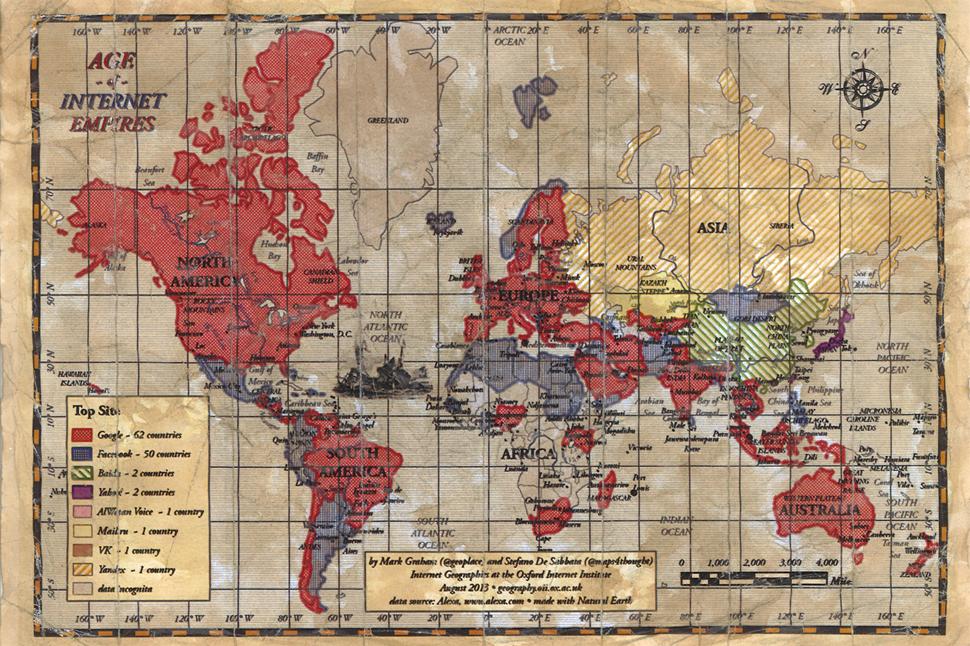
IT’S THE TALE OF INTERNET DOMINATION, TOLD THROUGH AN OLD TIMEY MAP
While it’s true that Web-related statistics are a thing to behold, digits aren’t nearly as impressive as seeing them represented in a visual masterpiece … which is exactly what Oxford Internet Institute researchers Stefano De Sabbata and Dr. Mark Graham did with a map they created illustrating the most visited websites in the world.
Entitled “Age of Internet Empires,” the project makes use of data sourced from Alexa. Two types of statistics were prominently used for the illustration: A site’s average number of unique users per day and the average number of views it receives per country. A website’s “territory” where it’s most visited by local users can be seen through the map’s thematic design.
According to the map (which the creators say was named after the popular game), this is what you need to know about every notable website’s claim for power.
1. Call me Captain Obvious, but let’s just go ahead and say it – Google is King of the Internet. Just look at the map.
2. Facebook may not have Google’s cosmic reach over the interwebs yet, but as of now it is, without a doubt, the King of Social Media. At least 50 countries consider the social network to be the number one staple in their everyday dose of the digital world, most of them located in the Middle East, North African, and Spanish-speaking American regions. However, the company’s rule over these territories isn’t completely free from Google’s influence; out of the 50 countries that have put Facebook in the top spot, 36 listed Google and 14 placed YouTube (which is Google-owned) in second place. Don’t get too cocky, Facebook.
3. Not a lot is known about countries within the Sub-Saharan African regions, but areas that have Internet connectivity mostly turn to – you guessed it – Google and Facebook for their online routine. Kenya, Madagascar, Nigeria, and South Africa are Google loyalists while Ghana, Senegal, and Sudan are more Facebook-inclined.
4. While Facebook has successfully infiltrated the Eastern hemisphere through its supremacy over the Philippines, other countries in the Asian region aren’t as swayed by Mark Zuckerberg’s brainchild; they’re also unimpressed by Google’s household-name status.
Among the many available search engines on the Internet, there is one contender that Google needs to keep an eye on if it wants to retain its dominance. Baidu is the most used search engine in China (also where Facebook isn’t welcome), which incidentally is the country that has the world’s largest Internet population comprised of more than half a billion users. Baidu is also the most viewed website in South Korea, besting Naver, the country’s local search engine.
Not to be forgotten as the search engine of yesteryear, Yahoo stakes its claim over Taiwan and Japan, the latter easily known to be one of the most technologically advanced countries in the world.
5. While Google and Facebook’s unquestionable popularity dominates most of the map, certain countries prefer their own versions of the two sites. Belarus does most of its social networking through VK, and Russia’s go-to search engine is Yandex. Instead of subscribing to the notion that Gmail is the only email service you will ever need, Kazakhstanis pick Mail.ru as their communication platform of choice. In Palestinian territories, visiting newspaper site Al-Watan Voice is preferable over Googling current news reports.
6. The data visualized by the Age of Internet Empires map has also been reproduced using a clearer hexagonal cartogram of the Internet Population 2011.
In this view, the sites’ ranking according to popularity shifts a little bit. Google still pretty much overshadows everything else as it accounts for more than one billion people who use the site regularly. That’s half of the entire Internet populace.
And as previously noted, China is responsible for over half a billion Internet users alone, and the fact that they all turn to Baidu for their online searching needs puts the site in second place, overtaking Facebook – despite its 1.15 billion monthly active users, only around 280 million call it their most visited site.
What does all this say about the future of the Web? “We are likely still in the very beginning of the Age of Internet Empires,” wrote De Sabbata and Graham on the map’s page in the Information Geographies website. “But, it may well be that the territories carved out now will have important implications for which companies end up controlling how we communicate and access information for many years to come.”
Image credit: Mark Graham and Stefano De Sabbata, Information Geographies
By Jam Kotenko — October 4, 2013
Read more: http://www.digitaltrends.com/social-media/age-of-internet-empires-map-proves-what-we-already-know-google-and-facebook-are-poised-for-world-domination/#ixzz2gqmjKR7d
Follow us: @digitaltrends on Twitter | digitaltrendsftw on Facebook
10 Things You Probably Didn't Know About the iPhone
10 Things You Probably Didn’t Know About the iPhone from NextWorth takes a look at some of the amazing stats and facts about Apple’s flagship product.
Designed by InfoNewt, this infographic is a good case study in topic selection and release timing. September was a month full of Apple iPhone news and hysteria surrounding the release of the new iPhone 5S, the iPhone 5C and the major upgrade to iOS 7. There were a bunch of infographics released about the rumors surrounding the new phones, but as soon as the new iPhones were officially announced all of the rumor designs became obsolete.
The topic choice and data visualized in this design has a much longer online lifespan. The content about the history and growth of the iPhone will be relevant for at least a year, maybe longer. The infographic will continue to drive traffic and links to the NextWorth site.
Designed by InfoNewt, this infographic is a good case study in topic selection and release timing. September was a month full of Apple iPhone news and hysteria surrounding the release of the new iPhone 5S, the iPhone 5C and the major upgrade to iOS 7. There were a bunch of infographics released about the rumors surrounding the new phones, but as soon as the new iPhones were officially announced all of the rumor designs became obsolete.
The topic choice and data visualized in this design has a much longer online lifespan. The content about the history and growth of the iPhone will be relevant for at least a year, maybe longer. The infographic will continue to drive traffic and links to the NextWorth site.
mardi 1 octobre 2013
History of pomegranate
Pomegranates are grown as both a fruit crop and as ornamental trees or shrubs for parks and gardens. They are tolerant of drought and moderate frost, growing in climates similar to the Mediterranean region, California, or Northern India. There are many genotypes, with the differences ranging from exocarp and aril color, hardness of seed, fruit size, juice content and astringency, and so on. The pomegranate has become increasingly popular in the countries of North America over the last few decades.
The pomegranate is one of the world's most ancient foods
The name pomegranate comes from Medieval Latin meaning "seeded apple." It has been named in many ancient texts from the Book of Exodus in the Torah, the Quran, the Homeric Hymns, and Mesopotamian records, to name a few. The pomegranate originally came from Persia, or modern day Iran, and the western Himalayas. It has been cultivated for millennia in places such as Iran, Iraq, Afghanistan, Pakistan, India, Russia, and the Mediterranean region (http://en.wikipedia.org/wiki/Pomegranate). It migrated as far east as China and Southeast Asia and was found along the Silk Road as a symbol of abundance and posterity. It is also grown extensively in Korea, Japan, and Latin America, having been introduced there by settlers or traders.
Archaeologists have found carbonized pomegranate exocarps in places such as Jericho from the Early Bronze Age (3000 BC), Cyprus, from the Late Bronze Age, and in Egyptian tombs, including King Tut's. Pomegranates were highly valued in Ancient Egypt, and were part of the supply of fruits required in a pharaoh's residence (1600 BC). It was revered enough to have been painted on walls and tombs to symbolize life after death. The pomegranate had many uses, including the fruit as food, the juice as a tonic to kill parasites, the blossom was crushed to make a red dye, and the peel was used to dye leather. (http://www.pomwonderful.com)
Other ancient sightings of the pomegranate include on the pillars of the Solomon's temple in Jerusalem, on the robes of Jewish priests, and in mosaics from ancient Rome (including Pompeii) where it was called the "Phoenician apple." Its twigs were worn on Roman women's headdresses to signify marital status. In Zoroastrian temples, pomegranates were used to symbolize eternal life and were associated with fertility. A symbol of strength in ancient Persia, the army of Xerxes carried spears with pomegranates on the tip (instead of spikes) when they invaded Greece in 480 BC. (http://www.foodreference.com/html/a-pomegranate-history.html). Pomegranates were also depicted on the walls of the royal palace and fortress Alhambra of the Islamic Nasrid Dynasty by the Moors in Spain. They even renamed one of their cities after the fruit. It also has a place of significance in Armenian culture.
More than just a nutritious food source, the pomegranate was an integral part of many cultures.
In many cases, the pomegranate surpassed its status as a highly celebrated source of food, and became part of the lore and legends of a culture. It was celebrated by the Buddha, and was considered one of the three blessed fruits, often being represented in Buddhist art. It was also depicted on the Temple of the Founder of Zen, to honor Bodhidharma.
Another example is how prominently the pomegranate was featured in Greek myths (approximately 500 BC). Most of us remember how Hades tempted Persephone with a pomegranate, and when she partook, it bound her to him as pomegranates symbolize the indissolubility of marriage. This is how Greek legend explains the seasons: when Persephone is in the Underworld with her husband, it is winter; when she rejoins her mother every year, we have spring.
Pomegranates have been a central part of many religions. Over the centuries, pomegranates were featured on Jewish money, furnishings, and religious objects. Around 600 AD Islam's Muhammad had high regard for the pomegranate, considering it to be nutritious for both physical and emotional health. Legend has it that each pomegranate contains one aril descended directly from paradise (http://www.foodreference.com/html/a-pomegranate-history.html). By 1500 AD, the pomegranate had also become an important symbol in Christianity, representing Jesus' resurrection. It was also used to symbolize The Virgin Mary because "both are filled with sweetness," and like a pomegranate she is said "to have within her many benefits for humankind, all revealed in Christ." (EDITOR'S NOTE: NOT SURE IF WE SHOULD LEAVE THIS PART ABOUT JESUS AND MARY, WHAT DO YOU THINK?) In India, the pomegranate has been a Hindu symbol of prosperity and fertility for centuries and is thought to bring good health. The pomegranate is featured prominently in Hindu art, being found on several avatars of Ganesha. (http://www.pomwonderful.com/about/pomegranate-history-legend/asia/)
As the pomegranate made its way to Europe, it had become more of a symbol than a food, and was portrayed regularly in art, literature, religion, and mythology. Eventually the western cultures come to value the pomegranate for its medicinal properties, and it was featured in heraldry, being found on the heraldic crests of many medical institutions including the British Medical Association(http://www.pomwonderful.com/about/pomegranate-history-legend/europe/). As it spread throughout Europe, the pomegranate came to appear on several coats of arms and symbolize noble birth.
The pomegranate made it to the new world via Spanish missionaries. When Cortez conquered the Aztecs in the 1500s, pomegranate trees were planted in Mexico, then made their way north to missions in California and Texas. It spread across the south but did not do well in the northern climates. In 1771, Thomas Jefferson planted pomegranates at Monticello, his plantation in Virginia. Around the year 2000, pomegranate popularity began to grow again as this sweet, juicy, succulent fruit was rediscovered. It's availability around the United States increased as a result.
Pomegranates are one of the most popular superfoods readily available today
Archaeologists have found carbonized pomegranate exocarps in places such as Jericho from the Early Bronze Age (3000 BC), Cyprus, from the Late Bronze Age, and in Egyptian tombs, including King Tut's. Pomegranates were highly valued in Ancient Egypt, and were part of the supply of fruits required in a pharaoh's residence (1600 BC). It was revered enough to have been painted on walls and tombs to symbolize life after death. The pomegranate had many uses, including the fruit as food, the juice as a tonic to kill parasites, the blossom was crushed to make a red dye, and the peel was used to dye leather. (http://www.pomwonderful.com)
Other ancient sightings of the pomegranate include on the pillars of the Solomon's temple in Jerusalem, on the robes of Jewish priests, and in mosaics from ancient Rome (including Pompeii) where it was called the "Phoenician apple." Its twigs were worn on Roman women's headdresses to signify marital status. In Zoroastrian temples, pomegranates were used to symbolize eternal life and were associated with fertility. A symbol of strength in ancient Persia, the army of Xerxes carried spears with pomegranates on the tip (instead of spikes) when they invaded Greece in 480 BC. (http://www.foodreference.com/html/a-pomegranate-history.html). Pomegranates were also depicted on the walls of the royal palace and fortress Alhambra of the Islamic Nasrid Dynasty by the Moors in Spain. They even renamed one of their cities after the fruit. It also has a place of significance in Armenian culture.
More than just a nutritious food source, the pomegranate was an integral part of many cultures.
In many cases, the pomegranate surpassed its status as a highly celebrated source of food, and became part of the lore and legends of a culture. It was celebrated by the Buddha, and was considered one of the three blessed fruits, often being represented in Buddhist art. It was also depicted on the Temple of the Founder of Zen, to honor Bodhidharma.
Another example is how prominently the pomegranate was featured in Greek myths (approximately 500 BC). Most of us remember how Hades tempted Persephone with a pomegranate, and when she partook, it bound her to him as pomegranates symbolize the indissolubility of marriage. This is how Greek legend explains the seasons: when Persephone is in the Underworld with her husband, it is winter; when she rejoins her mother every year, we have spring.
Pomegranates have been a central part of many religions. Over the centuries, pomegranates were featured on Jewish money, furnishings, and religious objects. Around 600 AD Islam's Muhammad had high regard for the pomegranate, considering it to be nutritious for both physical and emotional health. Legend has it that each pomegranate contains one aril descended directly from paradise (http://www.foodreference.com/html/a-pomegranate-history.html). By 1500 AD, the pomegranate had also become an important symbol in Christianity, representing Jesus' resurrection. It was also used to symbolize The Virgin Mary because "both are filled with sweetness," and like a pomegranate she is said "to have within her many benefits for humankind, all revealed in Christ." (EDITOR'S NOTE: NOT SURE IF WE SHOULD LEAVE THIS PART ABOUT JESUS AND MARY, WHAT DO YOU THINK?) In India, the pomegranate has been a Hindu symbol of prosperity and fertility for centuries and is thought to bring good health. The pomegranate is featured prominently in Hindu art, being found on several avatars of Ganesha. (http://www.pomwonderful.com/about/pomegranate-history-legend/asia/)
As the pomegranate made its way to Europe, it had become more of a symbol than a food, and was portrayed regularly in art, literature, religion, and mythology. Eventually the western cultures come to value the pomegranate for its medicinal properties, and it was featured in heraldry, being found on the heraldic crests of many medical institutions including the British Medical Association(http://www.pomwonderful.com/about/pomegranate-history-legend/europe/). As it spread throughout Europe, the pomegranate came to appear on several coats of arms and symbolize noble birth.
The pomegranate made it to the new world via Spanish missionaries. When Cortez conquered the Aztecs in the 1500s, pomegranate trees were planted in Mexico, then made their way north to missions in California and Texas. It spread across the south but did not do well in the northern climates. In 1771, Thomas Jefferson planted pomegranates at Monticello, his plantation in Virginia. Around the year 2000, pomegranate popularity began to grow again as this sweet, juicy, succulent fruit was rediscovered. It's availability around the United States increased as a result.
Pomegranates are one of the most popular superfoods readily available today
The pomegranate became popular in the Middle Eastern civilizations 6000 years ago largely because its dense nutrition and juice provided sustenance for long journeys. The superfood status of the pomegranate has only grown in modern times as nutritional research has come to decipher and understand the true power of the pomegranate's phytonutrients. India's Ayurvedic medicine has used pomegranates as a source for traditional remedies for thousands of years. For example, the bark of the tree and the fruit rind is used to stem diarrhea, dysentery, bladder problems, mouth ulcers, and intestinal parasites while the seeds and juice are considered a tonic for the heart. (http://en.wikipedia.org/wiki/Pomegranate)
The seeds in their casings, or arils, are the most desired part of the pomegranate, and they are consumed raw. Pomegranate juice can be sweet or sour depending on the variety, but most are moderate with some astringent notes due to the acidic tannins. Pomegranates are rich in vitamin C, pantothenic acid, potassium, flavonoids, and other natural phenols such as ellagitannins, a powerful antioxidant. The pomegranate also has unsaturated oils, fiber, and many additional micronutrients, if you eat the seeds. (http://en.wikipedia.org/wiki/Pomegranate)
Some miscellaneous uses of pomegranates many may not know include that it is often used as a bonsai tree and that pomegranate juice is sweetened and thickened to make grenadine syrup for cocktails.
Throughout most of recorded history, our ancestors have had high regard for the pomegranate. Its immune boosting phytonutrients have shown to be an effective tool in preventing degenerative and inflammatory ailments such as cancer, heart disease, and arthritis (http://www.naturalnews.com/031068_pomegranate_superfood.html). Current research underway includes studies on how pomegranate components affect diseases such as diabetes, cancer, rhinovirus, the common cold, coronary artery disease, kidney disease, and brain injury.
Sources for this article include:
http://www.foodreference.com/html/a-pomegranate-history.html
http://www.pomwonderful.com
http://www.naturalnews.com/031068_pomegranate_superfood.html
Tuesday, October 01, 2013 by: Willow Tohi
Learn more: http://www.naturalnews.com/042282_pomegranates_history_superfood.html##ixzz2gS0cWHsW
The seeds in their casings, or arils, are the most desired part of the pomegranate, and they are consumed raw. Pomegranate juice can be sweet or sour depending on the variety, but most are moderate with some astringent notes due to the acidic tannins. Pomegranates are rich in vitamin C, pantothenic acid, potassium, flavonoids, and other natural phenols such as ellagitannins, a powerful antioxidant. The pomegranate also has unsaturated oils, fiber, and many additional micronutrients, if you eat the seeds. (http://en.wikipedia.org/wiki/Pomegranate)
Some miscellaneous uses of pomegranates many may not know include that it is often used as a bonsai tree and that pomegranate juice is sweetened and thickened to make grenadine syrup for cocktails.
Throughout most of recorded history, our ancestors have had high regard for the pomegranate. Its immune boosting phytonutrients have shown to be an effective tool in preventing degenerative and inflammatory ailments such as cancer, heart disease, and arthritis (http://www.naturalnews.com/031068_pomegranate_superfood.html). Current research underway includes studies on how pomegranate components affect diseases such as diabetes, cancer, rhinovirus, the common cold, coronary artery disease, kidney disease, and brain injury.
Sources for this article include:
http://www.foodreference.com/html/a-pomegranate-history.html
http://www.pomwonderful.com
http://www.naturalnews.com/031068_pomegranate_superfood.html
Tuesday, October 01, 2013 by: Willow Tohi
Learn more: http://www.naturalnews.com/042282_pomegranates_history_superfood.html##ixzz2gS0cWHsW
vendredi 27 septembre 2013
Kelvin Temperature Scale: Facts and History
Like other temperature scales, the freezing and boiling points of water are factors in establishing the scale’s range. There are 100 degrees between the temperate at which water freezes at (273.16 K) and boils (373.16 K).
Each unit on this scale, called a Kelvin rather than a degree, is equal to a degree on the Celsius scale. For this reason, just the K, not the degree symbol, is used when reporting temperatures in Kelvin. There are no negative numbers on the Kelvin scale, as the lowest number is 0 K.
The idea for the Kelvin scale was sparked by a discovery in the 1800s of a relationship between the volume and the temperature of a gas. Scientists theorized that the volume of a gas should become zero at a temperature of minus 273.15 C.
| The Kelvin scale compared to Celsius and Fahrenheit. Credit: Designua | Shutterstock |
Absolute zero
In 1848, Kelvin used this as a basis for an absolute temperature scale. He defined "absolute" as the temperature at which molecules would stop moving, or "infinite cold." From absolute zero, he used the same unit as Celsius to determine the increments.
Absolute zero cannot technically be achieved. However, scientists have been able to lower the temperature of matter to just a fraction of a Kelvin above absolute zero through techniques such slowing down particles using lasers.
The Kelvin scale was also influenced by the Carnot engine, a theory that examines the relationship between pressure, work and temperature. It is one of the fundamentals of physics and thermodynamics and is a measure of the efficiency of an engine.
Kelvin was a talented mathemetician, which played a role in some of his other inventions, including a device that led to the success of the telegraph cable and many nautical instruments.
His research into the nature of heat helped him form the second law of thermodynamics, which states that heat will not flow from a colder body to a hotter body. Kelvin's documentation of the law says that some of the heat from a high-temperature energy source will be downgraded to low-quality energy.
Uses of the Kelvin scale
The Kelvin scale is popular in scientific applications because of the lack of negative numbers. This scale is convenient for recording the very low temperatures of liquid helium and liquid nitrogen, for example. The lack of negative numbers also makes it easier to calculate differences between temperatures, such as saying one temperature is three times another temperature.
Another absolute temperature scale, the Rankine temperature scale, is used in some engineering applications.
Kelvin is also used for pinpointing color temperature and is typically used in lighting. In a lighting application, Kelvin temperature represents the color temperature, such as white, blue or bright red, that relates to the physical temperature of an object.
During his research, Kelvin heated a block of carbon, progressing from a dim red light, increasing to a brighter yellow as the temperature increased and ultimately a bright blue-white glow at the highest temperatures.
Conversion rates
Kelvin to Fahrenheit: Subtract 273.15, multiply by 1.8, then add 32.
Fahrenheit to Kelvin: Subtract 32, multiply by 5, divide by 9, then add 273.15.
Kelvin to Celsius: Add 273
Celsius to Kelvin: Subtract 273
By Kim Ann Zimmermann, LiveScience Contributor | September 27, 2013 12:56am ET
http://www.livescience.com/39994-kelvin.html
jeudi 26 septembre 2013
The History of Mankind As Explained By Math
Ancient Egyptian art, via Wikimedia
The thing that's so great about history is that understanding it can help us predict the future, and then hopefully not screw it up as badly as we did the past.
A team of history-loving mathematicians from University of Connecticut, University of Exeter, and National Institute for Mathematical and Biological Synthesis recently set out to do just that, only with a very unusual approach: They mathematized 3,000 years of history. In doing so, the researchers claim to have answered some of the most complex questions about human society with a single equation.
The team tackled the mysteries of mankind's "ultrasociality"—basically, how it's possible for millions of people to live together in a defined society without killing each other (for the most part). What makes societies form, and what makes them thrive? How did a group of humans in Northern Africa become Egyptians? Why did Mesopotamia develop into what we know today as the Middle East?
While historians and sociologists have been exploring those kinds of questions for centuries, the authors of the study, published yesterday in the Proceedings of the National Academy of Sciences, realized that no one had yet taken a quantitative approach.
They created simulation of the geography of Afro-Eurasia between 1,500 BCE and 1,500 CE. Then they developed a mathematical model to explain and predict evolutionary behavior from that time period. Next, they applied the model to what really happened—insofar that we've collected and recorded that historical data, at least. To their surprise, researchers found that their equation had a 65 percent accuracy in predicting how humans spread and formed societies over time.
What made the quantitative analysis work so was one particular, ever-reliable clue about mankind's social behavior: war. Warfare—and in particular, the spread of military "weapons" like horses and cavalry—was the number one factor in identifying patterns and accurately predicting our cultural evolution. It makes perfect logical sense. Conflict against other people defines who is "us" and who is "them." Individuals forge bonds when we unite against a common enemy.
"The emergence and spread of technologies enabled more intense forms of warfare that, in turn, created selection pressures for the cultural evolution of norms and institutions, making possible cooperating groups numbering in the millions," the authors explain in the report.
Along with war, geography, agriculture, habitat, and other natural factors helped build the mathematical model. But there's a glaring X factor that was left out of the equation (literally), and that's culture. Yes, farms and spears will go a long way in analyzing broad historical patterns. But they're never going to tell the entire, nuanced story of how millions of humans interacted with each other, grouped together, broke apart, traveled together, traveled alone, fell in love, killed each other, and created traditions for thousands of years.
Still, the researchers believe adding some math-based logic to the study of human history can't hurt. "What's so exciting about this area of research is that instead of just telling stories or describing what occurred, we can now explain general historical patterns with quantitative accuracy," study coauthor Sergey Gavrilets said in a statement. "Explaining historical events helps us better understand the present, and ultimately may help us predict the future."
By Meghan Neal 1 day ago
mercredi 18 septembre 2013
L’Europe depuis l’an 1000
Remarquable petite vidéo qui retrace l’histoire européenne depuis l’an 1000 au travers d’une simple carte.
http://ordrespontane.blogspot.com/2013/09/leurope-depuis-lan-1000.html
dimanche 18 août 2013
A Brief Animated History of Physics
What we've learned is always interesting, but how we learned it is a great story as well. A cute animated video from the BBC Science Club tells us how the study of physics has evolved. (via Geeks Are Sexy)
Sunday, August 18, 2013
samedi 17 août 2013
Persian and Arab astronomers produced an improved version of the Greek armillary sphere in the 8th century
Persian and Arab astronomers produced an improved version of the Greek armillary sphere in the 8th century, and wrote about it in the treatise of Dhat al-Halaq or The instrument with the rings by the Persian astronomer Fazari (d.c. 777). Abbas Ibn Firnas (d.887) is thought to have produced another instrument with rings (armillary sphere) in 9th century which he gifted to Caliph Muhammad I (ruled 852-886).[11] The spherical astrolabe, a variation of both theastrolabe and the armillary sphere, was invented during the Middle Ages in the Islamic world.[12] The earliest description of the spherical astrolabe dates back to the Persian astronomerNayrizi (fl. 892-902). Muslim astronomers also independently invented the celestial globe, which were used primarily for solving problems in celestial astronomy. Today, 126 such instruments remain worldwide, the oldest from the 11th century. The altitude of the sun, or the Right Ascension and Declination of stars could be calculated with these by inputting the location of the observer on the meridian ring of the globe.
The armillary sphere was introduced to Western Europe via Al-Andalus in the late 10th century with the efforts of Gerbert d’Aurillac, the later Pope Sylvester II (r. 999–1003).[13]Pope Sylvester II applied the use of sighting tubes with his armillary sphere in order to fix the position of the pole star and record measurements for the tropics and equator.[14]
(via kenobi-wan-obi)
vendredi 16 août 2013
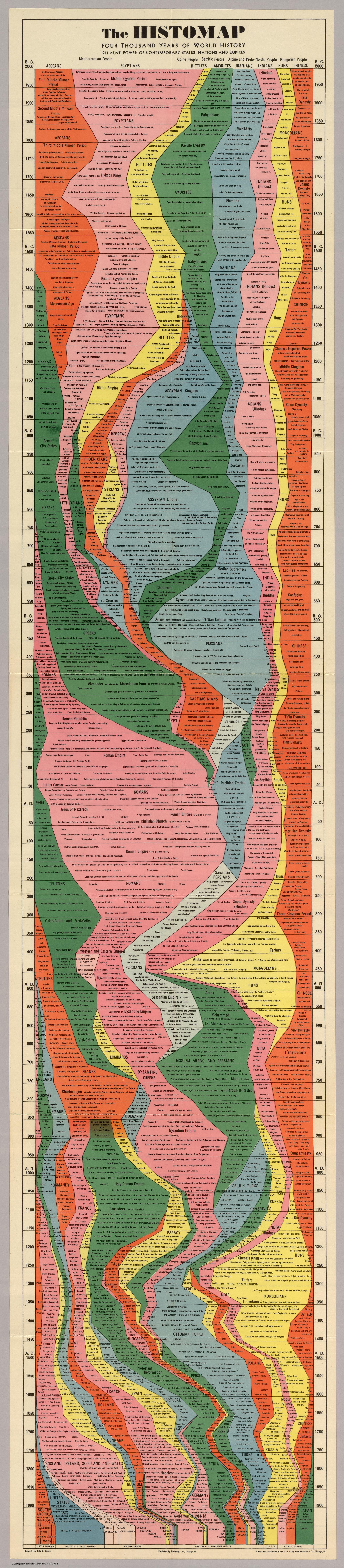
The Entire History of the World—Really, All of It—Distilled Into a Single Gorgeous Chart
The Vault is Slate's history blog. Like us on Facebook, follow us on Twitter @slatevault, and find us on Tumblr. Find out more about what this space is all about here.
This “Histomap,” created by John B. Sparks, was first printed by Rand McNally in 1931. (The David Rumsey Map Collection hosts a fully zoomable version here.) (Update: Click on the image below to arrive at a bigger version.)
This giant, ambitious chart fit neatly with a trend in nonfiction book publishing of the 1920s and 1930s: the “outline,” in which large subjects (the history of the world! every school of philosophy! all of modern physics!) were distilled into a form comprehensible to the most uneducated layman.
The 5-foot-long Histomap was sold for $1 and folded into a green cover, which featured endorsements from historians and reviewers. The chart was advertised as “clear, vivid, and shorn of elaboration,” while at the same time capable of “holding you enthralled” by presenting:
the actual picture of the march of civilization, from the mud huts of the ancients thru the monarchistic glamour of the middle ages to the living panorama of life in present day America.
The chart emphasizes domination, using color to show how the power of various “peoples” (a quasi-racial understanding of the nature of human groups, quite popular at the time) evolved throughout history.
It’s unclear what the width of the colored streams is meant to indicate. In other words, if the Y axis of the chart clearly represents time, what does the X axis represent? Did Sparks see history as a zero-sum game, in which peoples and nations would vie for shares of finite resources? Given the timing of his enterprise—he made this chart between two world wars and at the beginning of a major depression—this might well have been his thinking.
Sparks followed up on the success of this Histomap by publishing at least two more: the Histomap of religion (which I’ve been unable to find online) and the Histomap of evolution.

John B. Sparks, Histomap. 1931. David Rumsey Historical Map Collection
By Rebecca Onion
Posted Monday, Aug. 12, 2013, at 11:40 AM
This “Histomap,” created by John B. Sparks, was first printed by Rand McNally in 1931. (The David Rumsey Map Collection hosts a fully zoomable version here.) (Update: Click on the image below to arrive at a bigger version.)
This giant, ambitious chart fit neatly with a trend in nonfiction book publishing of the 1920s and 1930s: the “outline,” in which large subjects (the history of the world! every school of philosophy! all of modern physics!) were distilled into a form comprehensible to the most uneducated layman.
The 5-foot-long Histomap was sold for $1 and folded into a green cover, which featured endorsements from historians and reviewers. The chart was advertised as “clear, vivid, and shorn of elaboration,” while at the same time capable of “holding you enthralled” by presenting:
the actual picture of the march of civilization, from the mud huts of the ancients thru the monarchistic glamour of the middle ages to the living panorama of life in present day America.
The chart emphasizes domination, using color to show how the power of various “peoples” (a quasi-racial understanding of the nature of human groups, quite popular at the time) evolved throughout history.
It’s unclear what the width of the colored streams is meant to indicate. In other words, if the Y axis of the chart clearly represents time, what does the X axis represent? Did Sparks see history as a zero-sum game, in which peoples and nations would vie for shares of finite resources? Given the timing of his enterprise—he made this chart between two world wars and at the beginning of a major depression—this might well have been his thinking.
Sparks followed up on the success of this Histomap by publishing at least two more: the Histomap of religion (which I’ve been unable to find online) and the Histomap of evolution.
John B. Sparks, Histomap. 1931. David Rumsey Historical Map Collection
By Rebecca Onion
Posted Monday, Aug. 12, 2013, at 11:40 AM
vendredi 2 août 2013
Les Phéniciens, ces grands navigateurs
Partis de cités-Etats sur la côte libanaise, ils ont essaimé dans tout le monde antique, fondé un empire qui a fait trembler Rome, et auraient même bouclé le premier tour des côtes de l'Afrique. Retour sur un peuple fascinant, à qui nous devons beaucoup plus que nous ne le pensons.
Leurs villes étaient situées sur ce qui est aujourd'hui le littoral du Liban et de la Syrie. Certaines, comme Tyr et Sidon, existent encore. D'autres ont disparu, comme l'une des plus puissantes d'entre elles, Ougarit, rasée par des envahisseurs au XIIe siècle avant notre ère. Et ce peuple de marchands et de navigateurs a laissé des traces indélébiles dans notre histoire.
Leur nom, "phénicien", viendrait peut-être du grec "phoinix", la "pourpre" tirée du murex, dont ils étaient de grands exportateurs dans tout le monde antique. Mais il pourrait également s'agir d'une déformation grecque du mot égyptien "fenkhu", définissant les "Asiatiques", les habitants du Proche-Orient pour l'Egypte.
A partir du Xe siècle avant J.C., les Phéniciens commencent à se répandre au-delà de la Méditerranée orientale, après avoir établi des bases à Chypre. Ils créent des comptoirs sur la côte nord-africaine, jusqu'en Tunisie et en Algérie, mais aussi en Sicile, à Malte (voir article maltais), en Sardaigne, en Corse et dans le sud de l'Espagne. Peu à peu, la plus importante de ces nouvelles cités, Carthage, éclipse par son rayonnement les villes plus anciennes du Levant. Du IVe au IIe siècle avant J.C., elle devient une grande puissance qui fait trembler la république romaine sur ses fondations au cours des guerres puniques (dePoeni, Phéniciens, en latin), avant d'être détruite en 146 av. J.C.
Marins réputés pour leurs prouesses, les Phénciens étaient des navigateurs recherchés. Quand l'empire perse s'assure la mainmise sur la Phénicie au VIe siècle avant notre ère, ce sont eux qui constituent l'essentiel de sa flotte. Explorateurs, aventuriers, les Phéniciens avaient coutume de franchir les redoutables Colonnes d'Hercule (le détroit de Gibraltar) pour aller commercer jusqu'en Cornouailles, en quête d'étain.
Ils auraient ainsi donc pu atteindre les Açores, même si les preuves restent ténues, et il est attesté qu'ils faisaient escale dans les Canaries. Deux traditions rapportent qu'ils auraient même exploré les côtes de l'Afrique, beaucoup plus au sud. Dans L'Enquête, Hérodote soutient que le pharaon Nékao II, qui régna de -610 à -595, aurait organisé une expédition confiée à des marins phéniciens, à qui il demanda de faire le tour de la "Libye" (l'Afrique) en partant par la "mer Erythrée" (la mer Rouge) puis en passant au nord par les Colonnes d'Hercule. Les Phéniciens auraient mis trois ans à accomplir cet exploit. Même si cela ne paraît pas complètement impossible, Hérodote est la seule source à en faire état qui nous soit parvenue. En revanche, le Périple d'Hannon semble historiquement plus sûr. Hannon, explorateur carthaginois qui devint plus tard le roi de sa ville, se serait lancé dans une expédition vers 500 av. J.C. et aurait ainsi poussé jusqu'au large de l'actuel Cameroun avant de rebrousser chemin. Il relata ensuite ses aventures dans sonRécit du voyage du roi des Carthaginois Hannon autour des contrées qui sont au-delà des Colonnes d'Hercule, dont il subsiste une version grecque.
Au XVIIIe et au XIXe siècle, certains auteurs, impressionnés par les voyages bien réels des Phéniciens, ont prétendu qu'ils auraient pu découvrir l'Amérique longtemps avant les Vikings et Christophe Colomb. Une stèle contenant des inscriptions en phénicien aurait même été retrouvée à Paraiba, au Brésil, en 1872, mais beaucoup d'archéologues, contemporains et ultérieurs, ont considéré qu'il s'agissait d'un faux.
Qu'ils aient ou non traversé l'Atlantique, les Phéniciens nous ont fait un autre cadeau, essentiel au développement des civilisations occidentales : notre alphabet. L'alphabet latin, en effet, était au départ calqué sur l'alphabet grec, lequel s'était inspiré de l'alphabet phénicien.
COURRIER INTERNATIONAL
| Un navire phénicien gravé sur la face d'un sarcophage, au 2e siècle avant JC - Elie Plus/CC |
Leurs villes étaient situées sur ce qui est aujourd'hui le littoral du Liban et de la Syrie. Certaines, comme Tyr et Sidon, existent encore. D'autres ont disparu, comme l'une des plus puissantes d'entre elles, Ougarit, rasée par des envahisseurs au XIIe siècle avant notre ère. Et ce peuple de marchands et de navigateurs a laissé des traces indélébiles dans notre histoire.
Leur nom, "phénicien", viendrait peut-être du grec "phoinix", la "pourpre" tirée du murex, dont ils étaient de grands exportateurs dans tout le monde antique. Mais il pourrait également s'agir d'une déformation grecque du mot égyptien "fenkhu", définissant les "Asiatiques", les habitants du Proche-Orient pour l'Egypte.
A partir du Xe siècle avant J.C., les Phéniciens commencent à se répandre au-delà de la Méditerranée orientale, après avoir établi des bases à Chypre. Ils créent des comptoirs sur la côte nord-africaine, jusqu'en Tunisie et en Algérie, mais aussi en Sicile, à Malte (voir article maltais), en Sardaigne, en Corse et dans le sud de l'Espagne. Peu à peu, la plus importante de ces nouvelles cités, Carthage, éclipse par son rayonnement les villes plus anciennes du Levant. Du IVe au IIe siècle avant J.C., elle devient une grande puissance qui fait trembler la république romaine sur ses fondations au cours des guerres puniques (dePoeni, Phéniciens, en latin), avant d'être détruite en 146 av. J.C.
Marins réputés pour leurs prouesses, les Phénciens étaient des navigateurs recherchés. Quand l'empire perse s'assure la mainmise sur la Phénicie au VIe siècle avant notre ère, ce sont eux qui constituent l'essentiel de sa flotte. Explorateurs, aventuriers, les Phéniciens avaient coutume de franchir les redoutables Colonnes d'Hercule (le détroit de Gibraltar) pour aller commercer jusqu'en Cornouailles, en quête d'étain.
Ils auraient ainsi donc pu atteindre les Açores, même si les preuves restent ténues, et il est attesté qu'ils faisaient escale dans les Canaries. Deux traditions rapportent qu'ils auraient même exploré les côtes de l'Afrique, beaucoup plus au sud. Dans L'Enquête, Hérodote soutient que le pharaon Nékao II, qui régna de -610 à -595, aurait organisé une expédition confiée à des marins phéniciens, à qui il demanda de faire le tour de la "Libye" (l'Afrique) en partant par la "mer Erythrée" (la mer Rouge) puis en passant au nord par les Colonnes d'Hercule. Les Phéniciens auraient mis trois ans à accomplir cet exploit. Même si cela ne paraît pas complètement impossible, Hérodote est la seule source à en faire état qui nous soit parvenue. En revanche, le Périple d'Hannon semble historiquement plus sûr. Hannon, explorateur carthaginois qui devint plus tard le roi de sa ville, se serait lancé dans une expédition vers 500 av. J.C. et aurait ainsi poussé jusqu'au large de l'actuel Cameroun avant de rebrousser chemin. Il relata ensuite ses aventures dans sonRécit du voyage du roi des Carthaginois Hannon autour des contrées qui sont au-delà des Colonnes d'Hercule, dont il subsiste une version grecque.
Au XVIIIe et au XIXe siècle, certains auteurs, impressionnés par les voyages bien réels des Phéniciens, ont prétendu qu'ils auraient pu découvrir l'Amérique longtemps avant les Vikings et Christophe Colomb. Une stèle contenant des inscriptions en phénicien aurait même été retrouvée à Paraiba, au Brésil, en 1872, mais beaucoup d'archéologues, contemporains et ultérieurs, ont considéré qu'il s'agissait d'un faux.
Qu'ils aient ou non traversé l'Atlantique, les Phéniciens nous ont fait un autre cadeau, essentiel au développement des civilisations occidentales : notre alphabet. L'alphabet latin, en effet, était au départ calqué sur l'alphabet grec, lequel s'était inspiré de l'alphabet phénicien.
COURRIER INTERNATIONAL
1 AOÛT 2013
Vive la République de Phénicie !
L'île de Malte devrait revendiquer plus vigoureusement son patrimoine punique, affirmait le Times of Malta en octobre 2011.
| Le port de Marsaxlokk, à Malte, fondé par les Phéniciens au IXe siècle avant JC - Mirari Erdoiza/CC |
Parfois, des nations disparaissent ; emportées par l'Histoire, elles finissent divisées ou se mêlent à d'autres.
Comme les Romains de l'Antiquité, par exemple. Mais leur langue et leur culture n'ont pas disparu, elles. Plusieurs peuples d'Europe, comme les Italiens, les Espagnols et les Français, parlent des langues nées du latin. Sous une forme plus proche de ses origines, le latin a également été préservé dans les sciences et la religion.
Les Phéniciens n'ont pas eu cette chance. Ils ont presque été totalement engloutis par le temps. Commençons par revenir brièvement sur leur histoire. Peuple sémite, ils ont fondé des villes comme Tyr et Sidon sur la côte du Liban moderne. Plus tard, leurs cités-Etats se sont étendues sur les rivages de la Méditerranée. Citons entre autres Cadix en Espagne et Carthage en Afrique du Nord. Les Phéniciens se développaient non par la conquête, mais par l'expansion commerciale, en multipliant les échanges avec les nations voisines et en entretenant de bonnes relations avec elles.
Plus tard, la majorité de leurs villes a été conquise par les Perses, puis les Grecs et, au Moyen-Age, par les Arabes. Carthage a été celle qui a défendu son indépendance avec le plus d'acharnement, tenant longtemps la dragée haute à Rome, entre autres sous le commandement d'Hannibal. Pendant un temps, la cité a contrôlé les îles de Sicile, de Sardaigne et de Corse, ainsi que de vastes territoires dans le sud de l'Espagne.
Mais que nous ont laissé les Phéniciens ?
Tout d'abord, il y a quatre mille ans, ils ont développé un alphabet qui n'était pas basé sur des hiéroglyphes, mais sur des lettres distinctes associées à des sons distincts, dont découlent les alphabets grecs et romains, aujourd'hui utilisés par plus de la moitié du monde civilisé. Ils étaient aussi de courageux navigateurs. Ils ont atteint les rivages de l'Afrique longtemps avant le Portugais Vasco de Gama, et grâce à leur marine efficace, ils avaient établi des liens commerciaux dans l'ensemble du monde méditerranéen. Ils étaient également passés maîtres dans l'art de polir les métaux et de produire diverses teintures.
Où sont-ils passés ? Ont-ils été détruits, ou se sont-ils mélangés à d'autres peuples ? Certaines nations, non sans raison, disent avoir du sang phénicien. Et peut-être trouve-t-on encore des villes phéniciennes sur certaines îles de la Méditerranée ? Fort heureusement, c'est bien le cas.
Située en Méditerranée, Malte a une superficie totale de 316 kilomètres carrés et une population de 416 000 habitants qui sont les héritiers directs des antiques Phéniciens. Le mot "Malte" lui-même a des origines phéniciennes, signifiant "port", même si bien peu de Maltais le savent. Toutefois, les Arabes et les peuples d'Afrique ont eu une énorme influence sur les Maltais.
Prenant tous ces faits en considération, voici ce que je suggère :
La République de Malte devrait être rebaptisée République de Phénicie, le nom de Malte étant conservé pour l'une des îles ou la capitale.
Nous devrions élever des statues au grand navigateur Hannon, au chef militaire Hannibal et à d'autres Phéniciens de renom dans la capitale.
Si l'on suit ces recommandations, la République de Malte sera alors présentée au monde comme la République de Phénicie, le but étant de développer le tourisme, qui est aujourd'hui l'une des principales sources de revenus du pays.
Mais ce ne sont là que des recommandations, c'est aux habitants de Malte de décider comment ils veulent baptiser leur patrie.
THE TIMES OF MALTA
RUSTAM VAFOEV
Comme les Romains de l'Antiquité, par exemple. Mais leur langue et leur culture n'ont pas disparu, elles. Plusieurs peuples d'Europe, comme les Italiens, les Espagnols et les Français, parlent des langues nées du latin. Sous une forme plus proche de ses origines, le latin a également été préservé dans les sciences et la religion.
Les Phéniciens n'ont pas eu cette chance. Ils ont presque été totalement engloutis par le temps. Commençons par revenir brièvement sur leur histoire. Peuple sémite, ils ont fondé des villes comme Tyr et Sidon sur la côte du Liban moderne. Plus tard, leurs cités-Etats se sont étendues sur les rivages de la Méditerranée. Citons entre autres Cadix en Espagne et Carthage en Afrique du Nord. Les Phéniciens se développaient non par la conquête, mais par l'expansion commerciale, en multipliant les échanges avec les nations voisines et en entretenant de bonnes relations avec elles.
Plus tard, la majorité de leurs villes a été conquise par les Perses, puis les Grecs et, au Moyen-Age, par les Arabes. Carthage a été celle qui a défendu son indépendance avec le plus d'acharnement, tenant longtemps la dragée haute à Rome, entre autres sous le commandement d'Hannibal. Pendant un temps, la cité a contrôlé les îles de Sicile, de Sardaigne et de Corse, ainsi que de vastes territoires dans le sud de l'Espagne.
Mais que nous ont laissé les Phéniciens ?
Tout d'abord, il y a quatre mille ans, ils ont développé un alphabet qui n'était pas basé sur des hiéroglyphes, mais sur des lettres distinctes associées à des sons distincts, dont découlent les alphabets grecs et romains, aujourd'hui utilisés par plus de la moitié du monde civilisé. Ils étaient aussi de courageux navigateurs. Ils ont atteint les rivages de l'Afrique longtemps avant le Portugais Vasco de Gama, et grâce à leur marine efficace, ils avaient établi des liens commerciaux dans l'ensemble du monde méditerranéen. Ils étaient également passés maîtres dans l'art de polir les métaux et de produire diverses teintures.
Où sont-ils passés ? Ont-ils été détruits, ou se sont-ils mélangés à d'autres peuples ? Certaines nations, non sans raison, disent avoir du sang phénicien. Et peut-être trouve-t-on encore des villes phéniciennes sur certaines îles de la Méditerranée ? Fort heureusement, c'est bien le cas.
Située en Méditerranée, Malte a une superficie totale de 316 kilomètres carrés et une population de 416 000 habitants qui sont les héritiers directs des antiques Phéniciens. Le mot "Malte" lui-même a des origines phéniciennes, signifiant "port", même si bien peu de Maltais le savent. Toutefois, les Arabes et les peuples d'Afrique ont eu une énorme influence sur les Maltais.
Prenant tous ces faits en considération, voici ce que je suggère :
La République de Malte devrait être rebaptisée République de Phénicie, le nom de Malte étant conservé pour l'une des îles ou la capitale.
Nous devrions élever des statues au grand navigateur Hannon, au chef militaire Hannibal et à d'autres Phéniciens de renom dans la capitale.
Si l'on suit ces recommandations, la République de Malte sera alors présentée au monde comme la République de Phénicie, le but étant de développer le tourisme, qui est aujourd'hui l'une des principales sources de revenus du pays.
Mais ce ne sont là que des recommandations, c'est aux habitants de Malte de décider comment ils veulent baptiser leur patrie.
THE TIMES OF MALTA
RUSTAM VAFOEV
1 AOÛT 2013
samedi 13 juillet 2013
The Story of Physics
If you want a brief history of physics (hopefully in animated form) then you have come to the right place. This very cool video directed by Åsa Lucander and narrated by Dara O Briain gives you a pithy and humorous take on what has happened so far.
From Galileo through Newton to Einstein and beyond The Story of Physics gives you (almost) everything you ever wanted to know but were way too bored at school to ask… There's even a cameo by that darned cat...
Saturday, July 13, 2013
jeudi 11 juillet 2013
Former au digital : une histoire d’hommes et de femmes
Dans un monde digitalisé où tout va plus vite, où l’on valorise souvent la capacité de réaction au détriment de la réflexion, où l’urgence tient parfois lieu de culture professionnelle, il est de la responsabilité d’une école d’encourager chez ses étudiants la prise de hauteur et de recul. Et surtout, de retrouver la dimension humaine et relationnelle de la communication.
Professionnels de la communication digitale, entreprises et écoles avons un défi commun, une responsabilité pour l’avenir.
Les formations au web ne doivent pas simplement surfer sur les modes et les tendances. Revenons simplement à la mission même des écoles : développer le sens des responsabilités, forger l’esprit critique et la prise de recul à travers la culture générale, accompagner les étudiants dans leurs choix pour les aider à faire preuve de courage dans leurs prises de décisions.
Le web n’est plus le territoire du geek, la technique ne fait pas le savoir.
Alors que les outils numériques sont accessibles à tous, la création ne se substitue pas à la réflexion. C’est la dimension stratégique plus que la maîtrise technique qui fera la différence. Dans notre environnement complexe, où tout fait du bruit, il faut parfois savoir se taire, oser prendre le temps de réfléchir. Et ainsi redonner du sens et de la cohérence à chacun des projets développés.
Le digital apporte des changements : les prises de paroles sont démultipliées, tout est plus collectif, plus accessible, plus instantané et aussi plus anonyme. C’est pourquoi, il faut aux futurs communicants davantage d’organisation et d’anticipation pour optimiser les stratégies de communication, de la maîtrise de la langue pour renforcer la portée des discours des marques. Et aussi le sens de la responsabilité individuelle et collective, à l’heure où chacun se sent légitime pour s’exprimer sur tout.
L’école doit aussi innover, en apportant dans la pédagogie de nouveaux outils : l’apprentissage à distance pour favoriser la prise d’autonomie personnelle et professionnelle, multiplier les projets collaboratifs pour apprendre aux étudiants à travailler en réseau. Et aussi professionnaliser l’usage des réseaux sociaux.
Enseigner la communication numérique, c’est également lever les appréhensions que peut engendrer le digital et montrer ses leviers de développement : choisir un monde toujours plus ouvert, plus riche d’expériences, avec des perspectives d’évolutions fortes, dès lors que l’on s’appuie sur ce socle de connaissances porté par la culture générale.
Enfin, le digital c’est à la fois du dialogue avec des communautés, de l’échange et du partage de contenus, de l’écoute, de la création.
Autant d’activités qui supposent les qualités humaines et relationnelles des communicants : intelligence de l’autre et de son environnement, engagement, sincérité.
Le digital bouscule les codes établis et nous pousse à être tournés vers l’avenir. Les opportunités sont multiples, les défis sont nombreux.
Aujourd’hui, les écoles n’ont pas seulement un rôle de transmission, elles doivent incarner une vision du digital.
De belles perspectives s’ouvrent pour les prochaines générations : à nous, écoles, entreprises et professionnels, d’enseigner avec enthousiasme, de les guider avec énergie, de les préparer avec ardeur aux enjeux de la communication numérique, tant techniques que stratégiques.
Sans oublier que le digital est avant tout une histoire d’hommes et de femmes.
Virginie Munch, directeur général de l’ISCOM
Professionnels de la communication digitale, entreprises et écoles avons un défi commun, une responsabilité pour l’avenir.
Les formations au web ne doivent pas simplement surfer sur les modes et les tendances. Revenons simplement à la mission même des écoles : développer le sens des responsabilités, forger l’esprit critique et la prise de recul à travers la culture générale, accompagner les étudiants dans leurs choix pour les aider à faire preuve de courage dans leurs prises de décisions.
Le web n’est plus le territoire du geek, la technique ne fait pas le savoir.
Alors que les outils numériques sont accessibles à tous, la création ne se substitue pas à la réflexion. C’est la dimension stratégique plus que la maîtrise technique qui fera la différence. Dans notre environnement complexe, où tout fait du bruit, il faut parfois savoir se taire, oser prendre le temps de réfléchir. Et ainsi redonner du sens et de la cohérence à chacun des projets développés.
Le digital apporte des changements : les prises de paroles sont démultipliées, tout est plus collectif, plus accessible, plus instantané et aussi plus anonyme. C’est pourquoi, il faut aux futurs communicants davantage d’organisation et d’anticipation pour optimiser les stratégies de communication, de la maîtrise de la langue pour renforcer la portée des discours des marques. Et aussi le sens de la responsabilité individuelle et collective, à l’heure où chacun se sent légitime pour s’exprimer sur tout.
L’école doit aussi innover, en apportant dans la pédagogie de nouveaux outils : l’apprentissage à distance pour favoriser la prise d’autonomie personnelle et professionnelle, multiplier les projets collaboratifs pour apprendre aux étudiants à travailler en réseau. Et aussi professionnaliser l’usage des réseaux sociaux.
Enseigner la communication numérique, c’est également lever les appréhensions que peut engendrer le digital et montrer ses leviers de développement : choisir un monde toujours plus ouvert, plus riche d’expériences, avec des perspectives d’évolutions fortes, dès lors que l’on s’appuie sur ce socle de connaissances porté par la culture générale.
Enfin, le digital c’est à la fois du dialogue avec des communautés, de l’échange et du partage de contenus, de l’écoute, de la création.
Autant d’activités qui supposent les qualités humaines et relationnelles des communicants : intelligence de l’autre et de son environnement, engagement, sincérité.
Le digital bouscule les codes établis et nous pousse à être tournés vers l’avenir. Les opportunités sont multiples, les défis sont nombreux.
Aujourd’hui, les écoles n’ont pas seulement un rôle de transmission, elles doivent incarner une vision du digital.
De belles perspectives s’ouvrent pour les prochaines générations : à nous, écoles, entreprises et professionnels, d’enseigner avec enthousiasme, de les guider avec énergie, de les préparer avec ardeur aux enjeux de la communication numérique, tant techniques que stratégiques.
Sans oublier que le digital est avant tout une histoire d’hommes et de femmes.
Virginie Munch, directeur général de l’ISCOM
Publié le 10.07.2013 à 09H04, mis à jour le10.07.2013 à 18H12
http://www.letudiant.fr/educpros/opinions/former-au-digital-une-histoire-d-hommes-et-de-femmes.html
mercredi 3 juillet 2013
L’âge de l’Homme : comment les humains transforment la planète
Depuis cent ou deux cents ans, les êtres humains ne cessent de modifier le visage de la planète. Les géologues ont nommé ce nouveau chapitre de la Terre l’Antropocène. L’âge de l’Homme.
Libellés :
Anthropocène,
Anthropologie,
Histoire,
Modernité,
Ville
mercredi 17 avril 2013
Histoire - La course à l'espace depuis la Seconde Guerre mondiale
Order by
19 terms
Terms | Definitions |
|---|---|
http://quizlet.com/21892898/histoire-la-course-a-lespace-depuis-la-seconde-guerre-mondiale-flash-cards/
Inscription à :
Articles (Atom)