Affichage des articles dont le libellé est Traduction. Afficher tous les articles

samedi 5 octobre 2013

Des lunettes connectées pour fournir une traduction en temps réel


NTT Docomo a depuis peu dévoilé ses lunettes connectées durant le salon CEATEC de Tokyo. Loin des concepts habituels qui proposent autant de fonctionnalités que les smartphones, ces quasi google glass japonaises sont vouées à une seule mission : la traduction.

Dotées d’une caméra et d’un écran virtuel, ces lunettes intelligentes peuvent traduire une langue à une autre en temps réel. L’intérêt consiste à rompre les barrières linguistiques en proposant une traduction instantanée aux touristes grâce à un logiciel OCR. L’utilisateur peut ainsi s’en servir pour afficher des textes en japonais (le menu d’un restaurant ou les idéogrammes sur les panneaux) dans sa langue natale. Plus loin, les lunettes intègrent un module de reconnaissance faciale permettant à son porteur d’identifier une personne grâce aux données relevées. D’autres applications sont également envisageables avec ce système.

Ces lunettes traductrices sont encore à l’état de prototype pour le moment. D’ailleurs, l’opérateur nippon envisage de les peaufiner notamment au niveau de l’esthétique. Il compte toutefois les finaliser avant les Jeux Olympiques d’été de Tokyo, en 2020.


Par Anja François RANDRIAVANIAINA5 OCTOBRE 2013 11:00 - Source: Tom's Guide FR

lundi 30 septembre 2013

Vous ne lisez pas le japonais ? Des lunettes le font pour vous!

Les lunettes du japonais NTT Docomo
présentées au salon de l'électronique
Ceatec, en banlieue de Tokyo, le 30
septembre 2013 

© AFP Yoshikazu Tsuno
Chiba (Japon) (AFP) - Lire un menu de restaurant en japonais, rien de plus difficile pour un étranger au Japon, mais avec des lunettes traductrices, cela peut se faire en un clin d'oeil, tout comme la reconnaissance des personnes.

A l'occasion du salon de l'électronique Ceatec en banlieue de Tokyo, le premier opérateur de télécommunications mobiles local, NTT Docomo, a présenté plusieurs applications à base de lunettes munies d'une caméra et servant d'écran mono ou binoculaire.

L'une de ces fonctions permet de voir se substituer à l'image filmée une traduction en anglais d'un menu de restaurant écrit en japonais, ou bien dans d'autres langues au choix. L'utilisateur voit cette image "retouchée" via les lunettes.

Autre application possible: l'affichage à l'écran d'informations (nom, prénom, fonction, etc.) relatives à une personne que l'on rencontre et qui serait enregistrée dans le répertoire de son smartphone, le tout grâce à un système de reconnaissance/identification de visage.

NTT Docomo imagine aussi que toute surface plane rectangulaire (comme un cahier, un porte-feuille) puisse être assimilée à un pavé tactile sur lequel le doigt se pose et agit comme il le ferait sur l'écran d'un smartphone ou d'une tablette, à la différence près que l'image ne s'affiche que via les lunettes.

La reconnaissance des mouvements du doigt se fait grâce à une bague portée à l'index. Ses changements de position sont transmis au smartphone qui les traduit en instructions. Si bien que l'on manipule les images affichées sur l'écran des lunettes en agitant son doigt sur une surface quelconque.

Tout ou partie de ces technologies devraient être prêtes pour les jeux Olympiques de Tokyo en 2020, lesquels seront aussi une vitrine du savoir-faire des Japonais pour faciliter par divers moyens techniques la vie des visiteurs et notamment des étrangers de passage.

Toutefois, reste encore à s'affranchir d'ici-là de nombre d'obstacles techniques tels que la taille des lunettes, leur autonomie (car elles ont besoin d'une batterie), la rapidité de reconnaissance des images ou visages et la réduction du temps de réponse.

Lundi, 30 Septembre 2013 15:35

How Google Converted Language Translation Into a Problem of Vector Space Mathematics

To translate one language into another, find the linear transformation that maps one to the other. Simple, say a team of Google engineers


Computer science is changing the nature of the translation of words and sentences from one language to another. Anybody who has tried BabelFish or Google Translate will know that they provide useful translation services but ones that are far from perfect.

The basic idea is to compare a corpus of words in one language with the same corpus of words translated into another. Words and phrases that share similar statistical properties are considered equivalent.

The problem, of course, is that the initial translations rely on dictionaries that have to be compiled by human experts and this takes significant time and effort.

Now Tomas Mikolov and a couple of pals at Google in Mountain View have developed a technique that automatically generates dictionaries and phrase tables that convert one language into another.

The new technique does not rely on versions of the same document in different languages. Instead, it uses data mining techniques to model the structure of a single language and then compares this to the structure of another language.

“This method makes little assumption about the languages, so it can be used to extend and refine dictionaries and translation tables for any language pairs,” they say.

The new approach is relatively straightforward. It relies on the notion that every language must describe a similar set of ideas, so the words that do this must also be similar. For example, most languages will have words for common animals such as cat, dog, cow and so on. And these words are probably used in the same way in sentences such as “a cat is an animal that is smaller than a dog.”

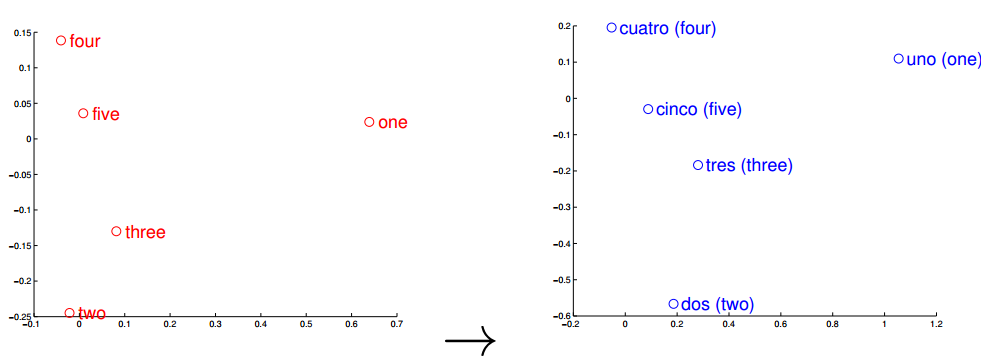
The same is true of numbers. The image above shows the vector representations of the numbers one to five in English and Spanish and demonstrates how similar they are.

This is an important clue. The new trick is to represent an entire language using the relationship between its words. The set of all the relationships, the so-called “language space”, can be thought of as a set of vectors that each point from one word to another. And in recent years, linguists have discovered that it is possible to handle these vectors mathematically. For example, the operation ‘king’ – ‘man’ + ‘woman’ results in a vector that is similar to ‘queen’.

It turns out that different languages share many similarities in this vector space. That means the process of converting one language into another is equivalent to finding the transformation that converts one vector space into the other.

This turns the problem of translation from one of linguistics into one of mathematics. So the problem for the Google team is to find a way of accurately mapping one vector space onto the other. For this they use a small bilingual dictionary compiled by human experts–comparing same corpus of words in two different languages gives them a ready-made linear transformation that does the trick.

Having identified this mapping, it is then a simple matter to apply it to the bigger language spaces. Mikolov and co say it works remarkably well. “Despite its simplicity, our method is surprisingly effective: we can achieve almost 90% precision@5 for translation of words between English and Spanish,” they say.

The method can be used to extend and refine existing dictionaries, and even to spot mistakes in them. Indeed, the Google team do exactly that with an English-Czech dictionary, finding numerous mistakes.

Finally, the team point out that since the technique makes few assumptions about the languages themselves, it can be used on argots that are entirely unrelated. So while Spanish and English have a common Indo-European history, Mikolov and co show that the new technique also works just as well for pairs of languages that are less closely related, such as English and Vietnamese.

That’s a useful step forward for the future of multilingual communication. But the team says this is just the beginning. “Clearly, there is still much to be explored,” they conclude.

Ref: arxiv.org/abs/1309.4168: Exploiting Similarities among Languages for Machine Translation

September 25, 2013