mercredi 27 juin 2012

Combien de temps faut-il pour construire un gratte-ciel?

Regardez cette vidéo et dites ce que vous en pensez.


Une entreprise chinoise de construction appelée Broad Sustainable Building (BSB) a construit un immeuble de 30 étages en seulement 15 jours.

La vidéo montre comment ils pourraient réussir dans leur prochain projet : ils veulent construire le bâtiment le plus haut du monde en 90 jours.

Une fois terminé, le bâtiment préfabriqué serait de 838 mètres. C'est plus de 10 mètres plus haut que Dubaï Burj Khalifa, le plus haut bâtiment du monde actuel. Il a fallu environ 5 ans pour construire le Burj Khalifa.

via Kottke.

http://thekidshouldseethis.com/post/25552163884?utm_source=feedburner&utm_medium=feed&utm_campaign=Feed%3A+TheKidShouldSeeThis+%28The+Kid+Should+See+This.%29 

11 belles et intéressantes passerelles autour du Monde

A footbridge or pedestrian bridge is a bridge designed for pedestrians and in some cases cyclists, animal traffic and horse riders, rather than vehicular traffic. Footbridges complement the landscape and can be used decoratively to visually link two distinct areas or to signal a transaction. In many developed countries, footbridges are both functional and can be beautiful works of art and sculpture.

1. BP Pedestrian Bridge, Illinois, USA


link
The BP Pedestrian Bridge, or simply BP Bridge, is a girder footbridge in the Loop community area of Chicago, Illinois, United States. This pedestrian bridge serves as a noise barrier for traffic sounds from Columbus Drive. It is a connecting link between Millennium Park and destinations to the east, such as the nearby lakefront, other parts of Grant Park and a parking garage.


link
BP Bridge uses a concealed box girder design with a concrete base, and its deck is covered by hardwood floor boards. It is designed without handrails, using stainless steel parapets instead. The total length is 935 feet (285 m), with a five percent slope on its inclined surfaces that makes it barrier free and accessible. Although the bridge is closed in winter because ice cannot be safely removed from its wooden walkway, it has received favorable reviews for its design and aesthetics. [link, map]


2. Capilano Suspension Bridge, Canada


link
The Capilano Suspension Bridge is Vancouver’s oldest tourist attraction, having been built in 1889. The current bridge is 450 feet (137m) across and 230 feet (70m) above the river. The Capilano Suspension Bridge and Park draws over 800,000 visitors a year. It offers splendid views of the river below and old growth forest. Experiencing the thrill of Vancouver's largest suspension bridge is a must for any local or visitor.


link
The bridge was originally built in 1889 by George Grant Mackay, a Scottish civil engineer and park commissioner for Vancouver. It was originally made of hemp ropes with a deck of cedar planks, and was replaced with a wire cable bridge in 1903. MacEachran purchased the Bridge from Mahon in 1935 and invited local natives to place their totem poles in the park, adding a native theme. In 1945, he sold the bridge to Henri Aubeneau. The bridge was completely rebuilt in 1956. [link, map]

3. Shaharah Bridge, Yemen


link
The Shaharah Bridge, Yemen, build to fight turkish invaders. The legend says that the local people can remove the bridge in few minutes in case of imminent danger.


link
This 17th century bridge was built to connect towns at the tops of mountains in the country of Yemen. It’s another scary bridge and a popular attraction with tourists, but the local residents still cross it regularly as a part of their daily routine. Shaharah bridge spans 300 meters (990 ft) deep gorge. [link]

4. Old Bridge, Bosnia and Herzegovina


link
Old Bridge (Stari Most) is a reconstruction of a 16th century Ottoman bridge in the city of Mostar, Bosnia and Herzegovina that crosses the river Neretva and connects two parts of the city.


link
The Old Bridge stood for 427 years, until it was destroyed on November 9, 1993 by Bosnian Croat forces during the Croat-Bosniak War. Subsequently, a project was set in motion to reconstruct it, and the rebuilt bridge opened in 2004. [link, map]

5. Trift Bridge, Switzerland


link
Trift Bridge is one of the most spectacular pedestrian suspension bridges of the Alps. It is 100 meters (330 ft) high and 170 meters (569 ft) long, and is poised above the region of the Trift Glacier. Even reaching the bridge through the ravine by cable car is an adventure.


link
The bridge spans the lake, Triftsee, near Gadmen, Switzerland in an area that receives approximately 20,000 visitors per year to see the Trift Glacier. An earlier bridge was built in 2004. A replacement bridge was opened on June 12, 2009. It was completed in only six weeks. [link1, link2, map]

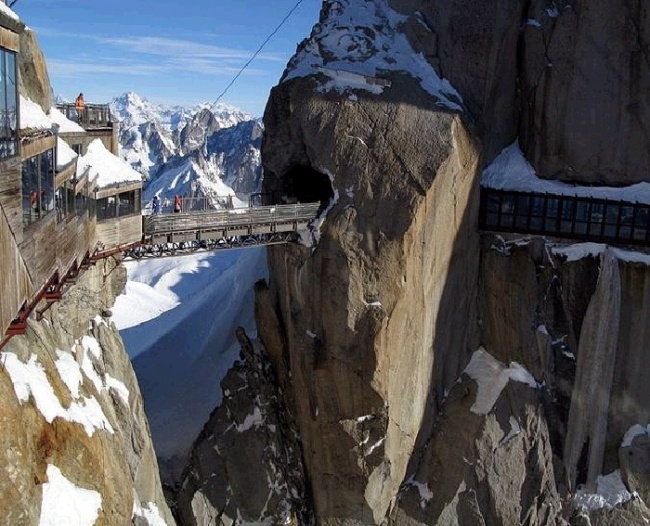
6. Aiguille du Midi Bridge, France


link
Built in the French Alps it represents an observation deck. In short, it’s a tiny bridge between two cliffs that connects two mountains and offers a marvelous view of the Mont Blanc massif.


link
The bridge is rather broad and firm, but the height (12,605 feet or 3.850 m above sea level) at which it is located, is terrifying. In line with that, the bridge is a real and unforgettable adventure for extreme lovers. [link]

7. Marienbrücke Bridge, Germany


link
Marienbrücke (Mary's Bridge) is a bridge located near the famous Neuschwanstein castlein Hohenschwangau, Bavaria. Many tourists each year visit the bridge to get a good view of the castle, and take pictures of themselves with it in the background. The bridge crosses a large gorge, with steep cliffs on both sides. Underneath runs a water fall from the surrounding mountains down into the valley.


link
The bridge itself is about 30 minutes walk away from the town of Hohenschwangau. The bridge can be crossed, and with a bit more walking up steep terrain, another famous lookout point for the castle can be reached. [link, map]

8. Puente de la Mujer, Argentina


link
Puente de la Mujer is a rotating footbridge for Dock 3 of the Puerto Madero commercial district of Buenos Aires, Argentina. It is of the Cantilever spar cable-stayed bridge type and is also a swing bridge, but somewhat unusual in its asymmetrical arrangement.


link
It has a single mast with cables suspending a portion of the bridge which rotates 90 degrees in order to allow water traffic to pass. When it swings to allow watercraft passage, the far end comes to a resting point on a stabilizing pylon. [link, map]

9. Rialto Bridge, Italy


link
Rialto Bridge is one oldest of the four bridges spanning the Grand Canal (Venice). The first crossing over the Canal was a pontoon bridge built in 1181. Thanks to the development of the Rialto Market the traffic on the bridge increased and by 1255 it was replaced by a wooden bridge. During the early 15th century, shops were built along the sides of the bridge which insured the money for maintenance (because of the taxes paid by shop owners).


link
It partially caught fire in 1310, while in 1444 it collapsed under the weight of the crowd watching a boat parade. It collapsed again in 1524. The present stone bridge was completed in 1591. On either side of the bridge there are rows of shops. [link, map]

10. Kingsgate Bridge, UK


link
Kingsgate Bridge is a striking, modern reinforced concrete construction footbridge across the River Wear, in Durham, England. It is a Grade I listed building. It was designed in 1963 by Sir Ove Arup personally, connecting Bow Lane on the historic peninsula in the centre of Durham to Dunelm House on New Elvet (to which building Arup's studio also contributed), and opened in 1966.


link
Kingsgate Bridge is thought to have been one of Arup's favourite designs of all, he having spent many hours working on every detail of the plans. Its construction was unusual. The two halves were each built parallel to the river, then rotated through 90° to make the crossing. [link, map]

11. Jade Belt Bridge, China


link
The Jade Belt Bridge, also known as the Camel's Back Bridge, is an 18th century pedestrian Moon bridge located on the grounds of the Summer Palace in Beijing, China. It is famous for its distinctive tall thin single arch.


link
The Jade Belt Bridge is the most well-known of the six bridges on the western shore ofKunming Lake. It was erected in the years 1751 to 1764, during the reign of the Qianlong Emperor, and was built in the style of the delicate bridges in the country-side of southern China. It is made from marble and other white stone. [link, map]

Bonus: Footbridge Out of Order - The Old Bridge of Konitsa, Greece


link
The old bridge of Konitsa over the river Aoos, one of the highest of its kind in Greece. Behind this bridge starts the Vikos-Aoos National Park. In winter, the river bed is completely covered with water.


link
Under the bridge, a bell can be seen; local villagers say that when the wind is strong enough to make the bell produce sound. It is too dangerous to cross the bridge. [link]

http://www.theworldgeography.com/2012/06/11-beautiful-interesting-footbridges.html

Government in South Korea rewards people for spying over their own citizens

Today I learned that the government in South Korea rewards people for spying over their own citizens. Many Koreans volunteer to become full-time snoopers whose job is to spot people who break various laws.


Professionally equipped, snoopers spend hours looking for their prey. Once they see someone breaking the law, they record the violator on video and pass the evidence to a relevant government authority.


In return for reporting violations, snoopers get rewards from the government which sometimes add up to $2,000 per month. This profitable activity has become a full-time job for many people in South Korea, especially housewives. There are even schools that teach you how to become a professional snooper in three months.


To give you an example, snoopers keep an eye out for school teachers, restaurant and beauty salon owners who overcharge their clients. They also report shop owners who give away plastic bags for free to their customers, which is against the law in South Korea. Needless to say, they spy on people who don’t park properly or whose dogs poo in parks.

Not surprisingly, there are specialised shops for snoopers that sell camcorder surveillance equipment such as these spy glasses.


Watch this video report about spying on shop owners who sell plastic bags and another oneabout schools that charge too much for tuition.

Thanks mastercom.me for the story.

http://todayilearned.co.uk/2012/06/20/government-in-south-korea-rewards-people-for-spying-over-their-own-citizens/

If you work in Britain, you get extra days off if you get sick during your holidays

This is a relatively new law. Your employer will have to give you extra days off should you get sick during your holidays.


Because no one wants to spend their vacation sick on the beach!

http://todayilearned.co.uk/2012/06/24/if-you-work-in-britain-you-get-extra-days-off-if-you-get-sick-during-your-holidays/

Estonia leads Europe by the number of start-ups per person

There are more start-ups per person in Estonia than in any other country in Europe, according to The Wall Street Journal.


This is not surprising. The country is home to Skype, NATO Cyber Defence headquarters and the first government ever elected online in 2005. Estonia is often called the new Silicon Valley and the “Start-up Nation”, a title for which it competes with Israel. To put things into perspective, every single school in Estonia had Internet access by the year 2000.

A formerly assembler programmer, Estonian president (Toomas Hendrik Ilves) uses a 27-inch iMac at work and owns a MacBook Air and an iPad2.

http://todayilearned.co.uk/2012/06/24/estonia-leads-europe-by-the-number-of-start-ups-per-person/

Un oiseau utilise un appât pour attraper des poissons


Cet oiseau utilise un appât pour attraper des poissons. Regardez !


dimanche 17 juin 2012

This is what rain looks like from the sky


Éduquer au numérique : il y a urgence !

13 juin 2012
Par 
Olivier Ertzscheid, maître de conférences à l’université de Nantes, publiait au mois d’avril un article dans Le Monde intitulé “Et si on enseignait vraiment le numérique ?“. Après l’espoir suscité par les possibilités offertes par le web (cf la déclaration d’indépendance du cyberespace de John Perry Barlow en 1996), l’auteur estime qu’au jour d’aujourd’hui, il ne reste plus rien de cette déclaration d’indépendance. Les contenus du web sont de plus en plus privatisés :
“la plus grande partie du cyberespace est un monde fermé, contrôlé par le marketing, régi par un carcan de normes arbitraires, de lois liberticides et de technologies “privatives”. Un monde hyperterritorialisé sous le contrôle de quelques multinationales.”
Cette évolution rend encore plus nécessaire une éducation au numérique, à ne pas confondre avec un enseignement informatique autour du code, de la programmation. L’important n’est pas de savoir programmer (voir la traduction sur Framasoft de l’article Please, don’t learn to code), mais plutôt de savoir publier :
“Enseigner l’activité de publication et en faire le pivot de l’apprentissage de l’ensemble des savoirs et des connaissances. (…) l’impossibilité de maîtriser un “savoir publier”, sera demain un obstacle et une inégalité aussi clivante que l’est aujourd’hui celle de la non-maîtrise de la lecture et de l’écriture, un nouvel analphabétisme numérique hélas déjà observable.”
En effet, être équipé d’outils numériques ne signifie nullement que les personnes sachent utiliser ces outils. L’accès à ces outils se démocratise, ce qui tend à réduire petit à petit la fracture numérique, mais une nouvelle fracture numérique se dessine. C’est la thèse relayée par l’article de Xavier de la Porte sur le site Internet Actu : Perdre son temps, la nouvelle fracture numérique, article qui se fait l’écho d’un autre article américain du New York Times. Les enfants des familles les plus pauvres passent plus de temps devant les écrans (télévision, réseaux sociaux, jeux, etc.) que les autres. Leurs parents surveillent moins ce qu’ils en font. Les ordinateurs et autres écrans sont massivement utilisés à des fins de divertissement et non pas pour un usage éducatif ou de création de contenu. La fracture numérique prend une autre forme, celui du “temps gaspillé“.
“Même si les enfants de familles éduquées jouent aussi beaucoup, le défi est donc accru pour les parents et enfants de familles défavorisés, ceux qui étaient censés profiter de la réduction de la fracture numérique. L’article montre ensuite que les conséquences peuvent parfois être désastreuses, notamment pour la scolarité.”
Le constat n’est certes pas nouveau, mais le phénomène s’amplifie. Je termine par une deuxième citation de Xavier de la Porte :
” ce que notent les chercheurs, c’est l’accroissement de l’écart, en temps et usage, un accroissement dû, et c’est un paradoxe à des politiques bienveillantes de démocratisation de l’accès. L’exemple américain pourrait inspirer une politique numérique en montrant qu’elle doit tenir sur deux jambes : accès d’un côté, éducations aux usages de l’autre… “

http://eduveille.hypotheses.org/4504 

Les murs ont la parole : que nous disent les bâtiments scolaires ?

4 juin 2012Par Marie Gaussel

Longtemps, « enseigner » n’a pas été synonyme de « faire la classe ». Les élèves sont désormais habitués à passer leurs journées entre quatre murs, mais lesquels ?

Devenu bâtiment spécifique, l’édifice scolaire a revêtu une fonction politique, sociale et pédagogique. Si la pierre semble défier le temps, la massification scolaire, le renouvellement de la pédagogie, les TICE – ainsi que la décentralisation en France - font changer l’école et donc l’espace scolaire.

Ce dossier du service Veille et Analyses n° 75 de mai 2012, proposé par Marie Musset, s’intéresse aux interrogations les plus récentes – et partagées par la plupart des pays- concernant l’architecture scolaire et sa mutation en « espace d’apprentissage » associant une réflexion sur l’espace à l’intégration pédagogique des ressources électroniques et à la prise en compte de la vision holistique de l’apprentissage.

Il faut dans ce cadre souligner l’intérêt de rechercher un langage commun entre usagers (élèves, enseignants, personnel éducatif, parents) architectes et maîtres d’ouvrage. En effet l’urbanisme ni l’architecture ne sont être au centre de la réflexion : ce qui est premier pour les éducateurs et les décideurs, c’est l’élève et sa réussite.

http://eduveille.hypotheses.org/4500

Quand les écossais se mobilisent pour faire réussir leurs étudiants…

13 juin 2012
Par Laure Endrizzi

… ça donne des programmes de recherche pluri-annuels sur des thématiques dédiées et une quantité de livrables tout à fait impressionnante…

J’avais déjà exploité les travaux réalisés sur “la première année d’enseignement supérieur” dans mon intervention aux journées Pédagogie universitaire numérique de l’IFÉ en janvier 2011, mais en y revenant aujourd’hui, je redécouvre en quelque sorte la richesse de ces travaux autour des enhancement themes, c’est-à-dire autour des thématiques structurantes pour penser la réussite étudiante…

Le programme de recherche en cours s’intitule “développer et soutenir les programmes d’enseignement” (Developing and Supporting the Curriculum) (2011-14) ; il vise à apporter des éléments de réponse aux questions suivantes :
- comment le curriculum au sens large est-il conçu et mis en oeuvre ?
- à qui est-il destiné ? comment le public étudiant évolue-t-il ?
- quel accompagnement est nécessaire auprès des personnels ?

Toutes les publications des recherches précédentes sont téléchargeables. Parmi les derniers thèmes traités, on retiendra :

– les diplômés du XXIe siècle / Graduates for the 21st Century (2008-11)
plus de 15 publications qui traitent des compétences à acquérir pour les jeunes diplômés d’aujourd’hui et de la manière dont ces compétences sont travaillées

– les relations entre recherche et enseignement / Research-Teaching Linkages: enhancing graduate attributes (2006-08)
une série de rapports qui examinent par discipline comment les étudiants développent des compétences de recherche

– la première année d’enseignement supérieur / The First Year: Engagement and Empowerment (2005-08)
plus de 10 rapports traitant de l’entrée dans les métiers d’étudiant

– l’évaluation intégrée / Integrative Assessment (2005-06)
avec des publications qui traitent de l’équilibre à mettre en oeuvre entre évaluation sommative et évaluation formative

– flexibilité de l’offre de cours / Flexible Delivery (2004-06)

Une des particularités de ces programmes de recherche, financés par le Scottish Higher Education Enhancement Committee (SHEEC), réside à la fois dans la diversité des méthodes employées et dans la pluralité des acteurs mobilisés, avec des réseaux de décideurs, des cadres des universités, des enseignants-chercheurs et des organisations étudiantes.

Les recommandations faites dans ces nombreux rapports ont-elles été opérationnalisées ? et avec quels résultats ? à voir…

http://eduveille.hypotheses.org/4515