Affichage des articles dont le libellé est ISS. Afficher tous les articles

mercredi 15 juillet 2015

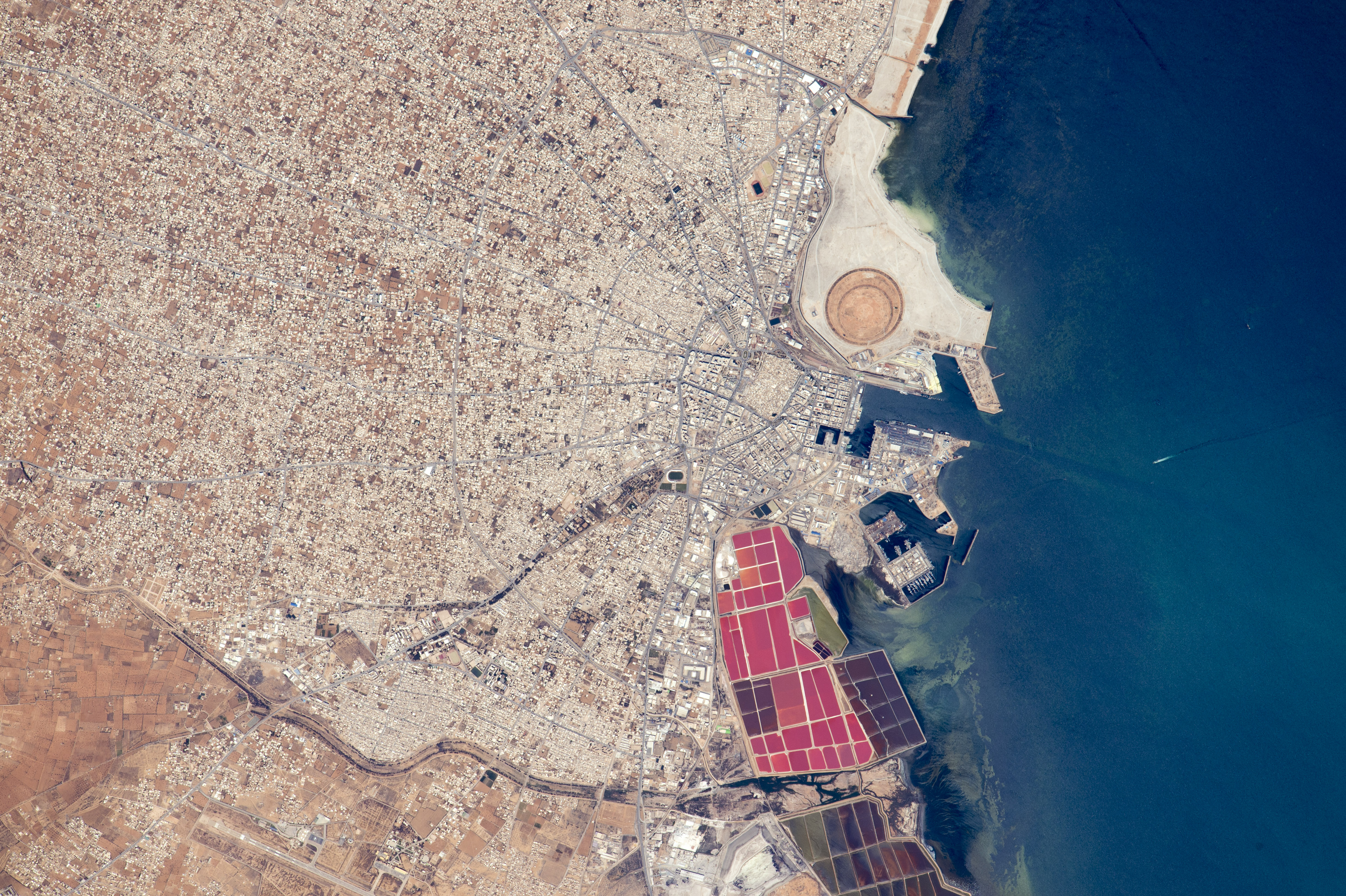
The Port of Sfax

The Port of Sfax
acquired June 15, 2015download large image (5 MB, JPEG, 4928x3280)
The Port of Sfax
acquired June 15, 2015
An astronaut aboard the International Space Station took this photograph showing the radiating street patterns of Tunisia’s second largest city, Sfax (population about 330,000). The radial pattern focuses on the ancient walled city—the “medina”with its small blocks, narrow streets, and even a slight color difference of the rooftops. The second photo is a tighter crop from the top photo.
Sfax is a major port and home to Tunisia’s largest fishing fleet; for scale, the fishing port is 1.1 kilometers (0.7 miles) long. Across the bottom of the full scene, the bed of an ephemeral river stretches to the sea.
For the astronauts, the most recognizable features of Sfax from space are the brilliantly colored salt ponds south of the old city and the new circular earth works of the Taparura redevelopment project just to the north. Taparura draws its name from the ancient town on which Sfax now stands. Engineers and developers have reclaimed many hectares of land along 5 kilometers (3 miles) of shoreline, reengineering a polluted and marshy area alongside the city’s railroad tracks.
Astronaut photograph ISS044-E-001998 was acquired on June 19, 2015, with a Nikon D4 digital camera using an 1150 millimeter lens, and is provided by the ISS Crew Earth Observations Facility and the Earth Science and Remote Sensing Unit, Johnson Space Center. The image was taken by a member of the Expedition 44 crew. The image has been cropped and enhanced to improve contrast, and lens artifacts have been removed. TheInternational Space Station Program supports the laboratory as part of the ISS National Lab to help astronauts take pictures of Earth that will be of the greatest value to scientists and the public, and to make those images freely available on the Internet. Additional images taken by astronauts and cosmonauts can be viewed at the NASA/JSC Gateway to Astronaut Photography of Earth. Caption by M. Justin Wilkinson, Texas State University, Jacobs Contract at NASA-JSC.
Instrument(s): 
ISS - Digital Camera

17-07-2015
http://earthobservatory.nasa.gov/IOTD/view.php?id=86200&src=eoa-iotd 

mardi 24 septembre 2013

Un bug informatique empêche l'arrimage de Cygnus à l'ISS

La capsule Cygnus a été envoyée dans l'espace pour ravitailler la Station spatiale internationale. Leur rencontre devait avoir lieu dimanche 22 septembre, elle est ajournée à mardi.

La capsule Cygnus, en route pour l'ISS. Vue d'artiste. Crédit Orbital Sciences.

On se souvient que la capsule Cygnus a été lancée la semaine dernière - c'était le 18 septembre - par la fusée Antares, depuis la base de Wallops, située sur une île près de la côte de Virginie (sud-est des États-Unis). Les lecteurs de Sciences et Avenir ont d'ailleurs pu assister au décollage en direct depuis notre site web.

BUG. Si cette opération, orchestrée par la compagnie privée Orbital Sciences, s'est parfaitement déroulée, les choses semblent désormais se compliquer...

Cygnus - une capsule inhabitée, transportant 700 kilos de matériels et de vivres - devait atteindre sa destination finale, la Station spatiale internationale, ce dimanche 22 septembre. Il n'en sera rien. Orbital Sciences vient en effet d'annoncer qu'un "problème de logiciel" ne permettra pas cet accostage aujourd'hui. Le bug en question empêche en effet la capsule Cygnus d'intercepter les communications par radio émises depuis l'ISS, nécessaires au rattachement de l'une à l'autre.

"RENDEZ-VOUS". La rencontre entre Cygnus et la Station spatiale pourra-t-elle avoir lieu ? Les ingénieurs d'Orbital Sciences assurent que oui; ils tablent désormais sur un "rendez-vous" pour le mardi 24 septembre, dans deux jours.

Rappelons que Orbital Sciences Corp est l'une des deux seules firmes américaines avec SpaceX retenues par la Nasa pour acheminer du fret à la Station spatiale internationale.

Publié le 22-09-2013 à 14h47 - Mis à jour le 23-09-2013 à 09h37

Par Olivier Lascar
Sciences et Avenir

jeudi 19 septembre 2013

Une fusée Antares d'Orbital Sciences pour l'ISS

WALLOPS ISLAND, Virginie, 18 septembre (Reuters) - Une fusée Antares de la société américaine Orbital Sciences doit placer mercredi en orbite une capsule chargée de matériel pour la Station spatiale internationale (ISS).

Le décollage est prévu de l'île de Wallops en Virginie à 10h50 (14h50 GMT).

La capsule Cygnus transporte 700 kg de denrées alimentaires, vêtements et autres fournitures. Si tout se déroule comme prévu, Cygnus se dirigera vers l'ISS dimanche.

Les astronautes utiliseront une grue robotisée pour tirer la capsule de son orbite et la récupérer. La capsule devrait rester arrimée à l'ISS jusqu'au 22 octobre et faire son retour dans l'atmosphère terrestre deux jours plus tard.

La fusée Antares et la capsule Cygnus ont été développées en partenariat avec la Nasa, qui a investi 288 millions de dollars (215 millions d'euros) dans le programme. Orbital Sciences n'a pas fourni le montant de son propre investissement, disant seulement qu'il s'agit d'une somme plus élevée que celle de la Nasa.

L'agence spatiale américaine, qui a mis au rebut ses navettes en 2011, a également mis près de 400 millions de dollars (300 millions d'euros) dans un projet similaire de la société Space Exploration Technologies (SpaceX) pour le développement de la fusée Falcon 9 et de son navire cargo Dragon.

Pour l'instant, la Nasa s'est engagée à effectuer huit missions Cygnus pour un contrat de 1,9 milliard de dollars (1,4 milliard d'euros). SpaceX a prévu 12 lancements, soit un contrat de 1,6 milliard de dollars (1,2 milliard d'euros), dont deux ont déjà été effectués. (Irene Klotz, Danielle Rouquié pour le service français, édité par Gilles Trequesser)

Article publié il y a 21 heures | Reuters

Dépêche © Thomson Reuters 2013 - Tous droits réservés.

- See more at: http://www.journal-aviation.com/actualites/24208-une-fusee-antares-d-orbital-sciences-pour-l-iss#sthash.D6aKbiey.dpuf

Premier lancement de fret vers l'ISS : les images du décollage


Premier lancement de fret vers l'ISS : les... par lemondefr

La fusée Antares a décollé mercredi à 10 h 58 (16 h 58, heure de Paris) de Virginie, aux Etats-Unis, afin de transporter Cygnus, une capsule non-habitée dont l'objectif est de ravitailler la Station spatiale internationale (ISS). Le lancement était assuré par Orbital Sciences, l'une des deux entreprises, avec SpaceX, retenues par la NASA pour acheminer du fret à l'ISS.

Le Monde.fr | 19.09.2013 à 10h08 • Mis à jour le 19.09.2013 à 10h27

lundi 16 septembre 2013

Hunting Earth's Mystery Lightning From the International Space Station


A Red Sprite taken from the ISS, via Wikimedia

For astronauts aboard the International Space Station, the view of the Earth isn’t just space age eye candy. It’s a unique perspective from which they can shed light on nagging questions about our home planet. It’s a perspective scientists exploit by sending remote experiments to the station in their stead, experiments like Firestation, which is designed to study the obscure side of a phenomenon we’re all pretty familiar with: lightning.


The lightning we all know and love (or hate, perhaps) is those jagged columns of light that heat the air to 50,000°F as they plunge from electrically charged clouds towards the Earth. But lightning doesn’t exclusively move down towards Earth from clouds. Lightning in the upper atmosphere can also move up from storm clouds into space.

It’s only recently that scientists discovered the strange lightning-related phenomena happening in the tops of clouds. There are red sprites, blue jets, and elves, cold forms of lightning that shoot upwards from storm clouds. There are strange jets of antimatter that also fly upwards, triggering the detectors on NASA's orbiting high-energy observatories. There are even gamma ray bursts that happen as often as 500 times a day during which Earth briefly mimics a supernova. These are known, appropriately, as Terrestrial Gamma-ray Flashes or TGFs.

Scientists know these phenomena exist, but no one is entirely sure how they relate to the lightning on the lower half of the cloud that we see during a thunderstorm. Hopefully this will change soon, thanks to Firestation, a package of sensors designed to explore the links between TGFs, ordinary lightning, and sprites.

Firestation’s principal investigator Doug Rowland from NASA's Goddard Space Flight Center calls the ISS the perfect platform from which to explore these cloud-top lightning phenomena. During the experiment’s one year lifetime, the ISS will carry the bevy of sensors over thousands of active thunderstorms. He hopes that from this vantage point, Firestation will see up to 50 lightning strikes per day and at least one TGF every few hours.


A diagram showing the relative heights of various forms of lightning. via

With each storm, Firestation will gather plenty of data. Unlike previous upper atmospheric lightning experiments, it has the unique ability to observe thunderstorms in multiple wavelengths at the same time. In one go the detector can record radio static from lightning; measure the optical glow of lightning, red sprites, and blu elves; and detect gamma-rays and electrons associated with TGFs and any other antimatter events.

The TGFs are of particular interest. Right now, scientists don’t know for sure which type of lightning produces the surprisingly high-energy gamma-ray flashes they’ve seen. Gamma-rays are thought to come from the hottest and violent places in the universe, so their appearance at the top of our planet’s cold atmosphere is quite a surprise. Something up there is accelerating low-energy particles of air to nearly the speed of light to produce this gamma-radiation and the occasional burst of antimatter. Scientists want to know what this “something” is, and Firestation is going to unlock the mystery.

After gathering data from so many types of phenomena across so many wavelengths, researchers should be able to sort out the cause-and-effect connections between these lighting events.

Firestation was delivered to the ISS on Aug. 3, 2013, by the Japanese robotic cargo vessel Kounotori-4. It’s already been installed on the station’s exterior and the sensors have been checked out. All that’s left is to start the experiment, which is slated to happen this month. Once Firestation is up and running, scientists expect it will be only a matter of weeks before the biggest mysteries of upper atmospheric lightning are answered, adding these phenomena to the list of questions answered thanks to the space age.

By Amy Teitel 18 hours ago

Un cargo spatial européen rehaussera l'orbite de l'ISS de 900m


Station spatiale internationale© Photo NASA

Les spécialistes du Centre russe de contrôle des vols (TsOUP) relèveront dimanche de 900m l'orbite de la Station spatiale internationale (ISS)à l'aide du cargo spatial européen ATV-4 Albert Einstein, a annoncé à RIA Novosti un porte-parole de l'Agence fédérale spatiale russe (Roskosmos).

"Les moteurs du vaisseau de transport européen seront mis en marche dimanche à 16h42 (heure de Moscou) et fonctionneront pendant 204,22 secondes. L'ISS recevra une impulsion de 0,5 mètre par seconde. A l'issue de cette manœuvre, l'altitude moyenne de l'orbite de l'ISS augmentera de 900m pour constituer 415,8km", a indiqué la source.

Le porte-parole de l'agence Roskosmos a précisé cette opération était appelée à créer des conditions optimales pour l'arrimage du vaisseau habité russe Soyouz TMA-10M transportant le nouvel équipage de l'ISS, dont le tir est prévu le 26 septembre prochain. L'équipage comprendra les Russes Oleg Kotov et Sergueï Riazanski et l'astronaute de la NASA Michael Hopkins.

15:27 15/09/2013

MOSCOU, 15 septembre - RIA Novosti